The CPT rig we deploy across London carries a 20‑tonne reaction frame and a standard 60° cone with a 10 cm² cross‑sectional area, pushing at a steady 20 mm/s through the ground. In the central boroughs, where the London Clay formation can exceed 40 m in thickness, we regularly record cone resistances between 1.5 and 3.5 MPa in the upper weathered zone, dropping to 0.8–1.2 MPa in the unweathered clay below. The pore pressure sensor, positioned just behind the cone, captures the u2 response immediately, helping us distinguish between overconsolidated clay and sand lenses. Before mobilising the cone we always run a georradar (GPR) survey to locate buried solutions because the City’s Victorian infrastructure is notoriously dense. The entire operation is controlled from a data‑acquisition unit inside the truck, displaying real‑time graphs of qc, fs and u2 on a 15‑inch screen, and we log every 2 cm of penetration.
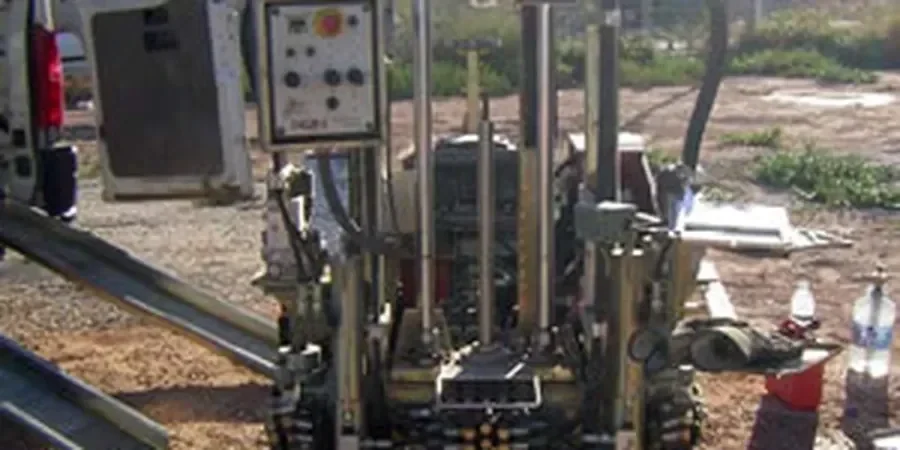
In London Clay the cone resistance profile reflects the overconsolidation ratio directly, giving engineers a parameter they can feed into settlement calculations from day one.
Scope of work
Area-specific notes
Eurocode 7 (EN 1997‑1:2004) requires that the design of foundations on London Clay accounts for the material’s high overconsolidation ratio (OCR typically 4–8) and its tendency to soften after excavation. A CPT sounding alone cannot detect the fissure network that controls the mass strength, so we always advise running the cone together with a vane shear test in the clay to measure the undrained shear strength directly. If the pore‑pressure trace shows a rapid dissipation during a pause, it indicates a permeable layer — often a silt seam in the Lambeth Group — that could cause localised settlement under load. The biggest risk in London is misinterpreting a thin gravel lens as a competent bearing stratum when, in fact, the underlying clay is still the dominant layer. Our reports flag these anomalies using the Soil Behaviour Type (SBT) chart from Robertson (1990), which classifies each 2‑cm reading into one of nine zones, giving the design team a transparent, auditable record of every layer transition.
Standards used
BS EN ISO 22476‑1:2012 – Geotechnical investigation and testing. Field testing. Electrical cone and piezocone penetration test, Eurocode 7 (EN 1997‑1:2004) – Geotechnical design. General rules, BS 5930:2015 – Code of practice for ground investigations
Linked services
Piezocone (CPTu) with Dissipation Tests
We equip the cone with a 5‑mm porous element behind the shoulder to measure pore pressure (u2) during and after penetration. Dissipation tests are performed at 1‑m intervals in clay, allowing us to estimate the in‑situ coefficient of consolidation (cv) directly from the decay curve. This is particularly valuable for projects on the Thames floodplain where soft alluvial clays require precise consolidation parameters for embankment design.
Seismic CPT (SCPTu) for Shear Wave Velocity
We add a seismic module with two triaxial geophones spaced 1 m apart to measure vs30/" data-interlink="1">shear wave velocity (Vs) at 1‑m depth intervals. The Vs profile is used to classify the site according to the National Annex of Eurocode 8 (seismic site class A, B or C), which is essential for tall buildings in the Docklands area where the London Clay can amplify low‑frequency ground motion. The test adds only 10 minutes per metre of sounding.
Typical parameters
Q&A
What is the difference between CPT and SPT for London Clay?
The CPT provides a continuous profile — every 2 cm — of cone resistance, sleeve friction and pore pressure, whereas the SPT gives discrete blow counts at 1‑m intervals. In London Clay, the CPT is far more sensitive to thin sand or silt layers that the SPT hammer might miss. The cone also measures pore pressure in real time, which helps identify the groundwater regime without installing a separate standpipe. For a typical 15‑m profile in the City, the CPT takes about 45 minutes of push time; an SPT borehole to the same depth can take a full day. However, the SPT remains the standard for obtaining disturbed samples for laboratory classification, so we often run both tests on the same site.
How much does a Cone Penetration Test cost in London?
The typical cost for a CPT sounding in London ranges from £130 to £200 per metre, depending on the depth, access conditions and the number of dissipation tests required. For a standard 15‑m profile with two dissipation tests, the total is usually between £1,950 and £3,000. This includes mobilisation within the M25, real‑time data acquisition and a full report with SBT classification. Deep soundings beyond 25 m or work in confined mews may carry a small surcharge for the tracked carrier.
Can CPT be used to design foundations on London Clay without boreholes?
No — the CPT alone cannot replace boreholes because it does not recover physical samples for index tests like Atterberg limits, natural moisture content or particle density. The cone gives an excellent continuous stratigraphic profile and reliable strength parameters when correlated with local databases, but the design of a foundation on London Clay still requires laboratory confirmation of the plasticity index (typically 40–60 %) and the undrained shear strength profile. We recommend a minimum of one borehole per 500 m² of site area, with the CPT filling the gaps between boreholes to capture lateral variability.