London's subsurface is dominated by the London Clay formation, a stiff to very stiff overconsolidated clay that can reach depths of over 40 metres in the central area. This material has high plasticity and low permeability, which makes classic laboratory testing on undisturbed samples challenging due to sample disturbance during extraction. For projects in the Thames floodplain or along the River Lea, we regularly encounter soft alluvial clays and peat layers where the field vane shear test (VST) is the most reliable method for determining undrained shear strength in situ. The test is performed by advancing a four-bladed vane into the soil at the base of a borehole and rotating it at a standard rate of 6 to 12 degrees per minute. Peak torque is recorded, converted to undrained shear strength using site-specific calibration factors, and then we measure the remoulded strength after ten rotations to obtain sensitivity. In practice, we combine the VST with calicatas exploratorias to visually log the soil profile and select representative test depths.
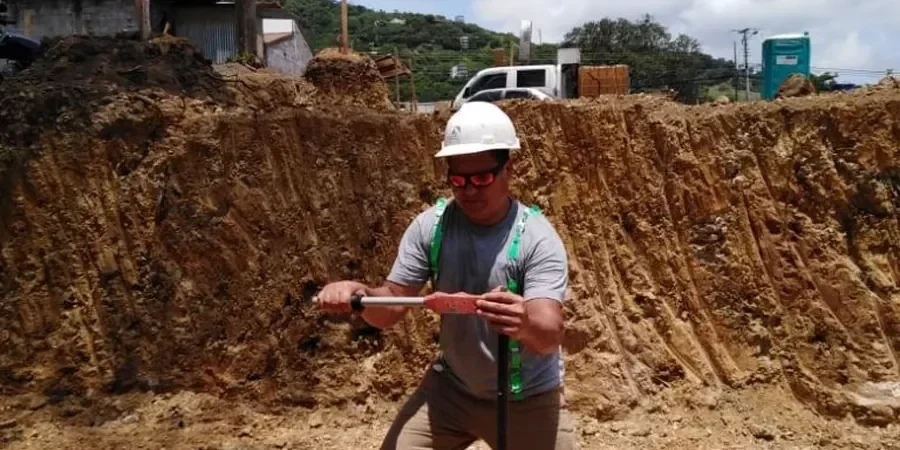
For London Clay, the field vane shear test gives you undrained strength directly in situ, avoiding sample disturbance errors that can reach 30% in triaxial tests.
Scope of work
Area-specific notes
A common mistake we see on London projects is relying solely on laboratory triaxial tests for undrained strength without accounting for sample disturbance. In London Clay, even with the best thin-walled samplers, you can lose 15 to 30% of the in situ strength due to stress release and handling. That leads to over-optimistic bearing capacity or factor of safety values. Our field vane shear test catches that gap by measuring strength in the ground as it is. We also see engineers forgetting to correct the vane strength for the plasticity index of the clay — BS EN 1997-2 gives a correction factor of 0.8 for high-plasticity clays like London Clay. Without that correction, you overestimate the real undrained strength by 20%, which can mean undersized foundations or unstable slopes along the M25 corridor.
Standards used
BS EN 1997-2:2007 – Ground investigation and testing (Eurocode 7), BS 1377-9 – Standard Test Method for Field Vane Shear Test in Saturated Fine-Grained Soils, ISO 17025 – General requirements for the competence of testing and calibration laboratories
Linked services
VST with Continuous Depth Profiling
We perform vane tests at 1.5 m intervals down the borehole depth, with real-time torque data logging. Suitable for sites with multiple soft clay layers, such as the alluvial deposits along the Thames Barrier area. Includes vane correction for plasticity index and a final report with undrained shear strength vs. depth graph.
Combined VST and Soil Sampling Service
For sites where you need both in situ strength and laboratory classification, we run the vane test at selected depths and take undisturbed push samples at the same levels. The undisturbed samples are then tested for water content, Atterberg limits, and triaxial compression in our UKAS-accredited lab. This gives you the full picture — strength in situ plus index properties.
Typical parameters
Q&A
What is the difference between field vane shear test and laboratory triaxial test for London Clay?
The field vane shear test measures undrained shear strength in situ, avoiding the sample disturbance that occurs when extracting London Clay cores for triaxial testing. Sample disturbance in stiff overconsolidated clays can reduce measured strength by 15–30%. The VST gives you the intact strength of the ground as it is. We then use the triaxial test to validate the strength profile and measure effective stress parameters for long-term stability analysis.
At what depths should vane tests be performed in London Clay?
For a typical 10 m borehole in London Clay, we recommend vane tests at 2 m, 4 m, 6 m, and 8 m depth. In softer alluvial clays near the River Thames or River Lea, we increase the frequency to every 1.5 m to capture thin soft layers. The vane test is only reliable in saturated fine-grained soils with undrained shear strength below 200 kPa, which covers most of the London Clay formation above 20 m depth.
How much does a field vane shear test cost in London?
A standard field vane shear test with 4 depth points and a full report typically ranges from £450 to £1,150 depending on site access, depth, and number of test points. Additional tests or continuous profiling increase the cost. We supply a fixed price quotation after a site visit or review of existing borehole logs.
What correction factors are applied to vane test results for London Clay?
BS EN 1997-2:2007 recommends applying a correction factor based on the plasticity index of the soil. For London Clay, which typically has a plasticity index between 40% and 60%, the correction factor is approximately 0.8. This means the measured peak torque is multiplied by 0.8 to obtain the design undrained shear strength. Without this correction, you overestimate the real strength by about 20%.