The unconfined compression test (UCS) is one of the quickest ways to estimate undrained shear strength in cohesive soils, and in London we run it constantly on block samples from the London Clay formation. Our setup uses a Wykeham Farrance frame with a 10 kN proving ring and a manual or motorised screw jack; we load the specimen at a strain rate of 1–2 % per minute until failure. Before testing we trim the sample to a 2:1 height-to-diameter ratio, measure moisture content, and note any fissures, which are common in the upper weathered zone of London Clay. The test is simple but demands strict adherence to BS 1377-7:1990 — trimming must be precise because a skewed end platen instantly invalidates the result.
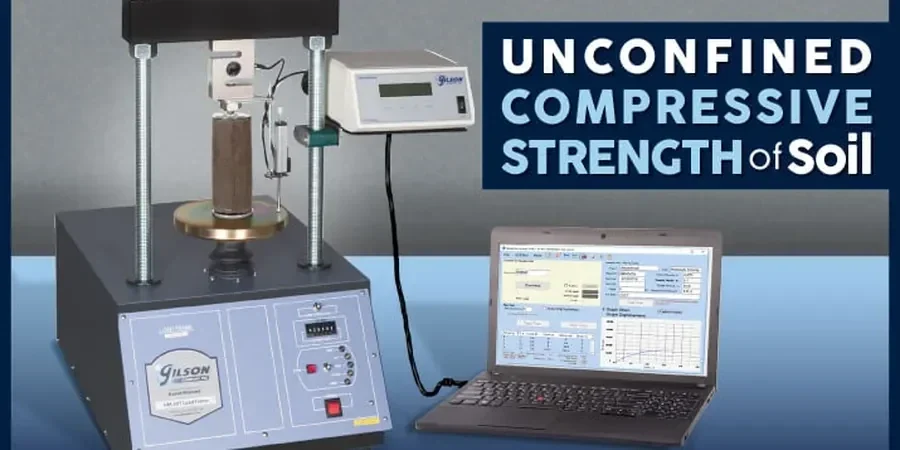
A single UCS on a block sample can confirm clay consistency class in London Clay, but fissures and sample disturbance can halve the measured strength if trimming is not careful.
Scope of work
Area-specific notes
London sits on a thick sequence of overconsolidated clay that has been subject to cycles of wetting, drying, and glacial loading. A single unconfined compression test (UCS) taken from a borehole at 5 m depth might show 180 kPa, while a test from the same horizon 3 m away could read 90 kPa because of a hidden silt lens. Relying on one point without understanding the spatial variability of London Clay is a common mistake; we have seen foundation designs revised after a second UCS campaign revealed a weaker zone than the initial SI suggested. The risk is not just bearing capacity but also heave — UCS data helps estimate swelling potential indirectly through the sensitivity ratio.
Watch how it works
Standards used
BS 1377-7:1990 (Unconfined compression test), BS EN 1997-2:2007 (Ground investigation and testing), BS 5930:2015 (Code of practice for site investigations)
Linked services
UCS on block samples
We extract undisturbed block samples from trial pits or trench sections and test them within 24 hours to minimise moisture loss. Ideal for shallow foundations and slope stability in London Clay.
UCS on thin-walled tube samples
For deep boreholes, we use 100 mm diameter thin-walled tubes with a stationary piston to obtain class 1 samples. The UCS is run in our temperature-controlled lab at 20 °C.
Multi-depth UCS profiling
When a single depth is not enough, we test specimens from every 1.0 m interval to build a continuous undrained shear strength profile. This is standard for piled foundations in central London.
Post-test index classification
After the UCS, we determine natural moisture content, bulk density, and Atterberg limits on the same sample to classify the soil and correlate strength with plasticity.
Typical parameters
Q&A
What is the difference between UCS and triaxial compression?
UCS applies axial load with zero confining pressure (cell pressure = 0), so it is applicable only to cohesive soils that can stand unsupported. Triaxial tests apply a confining pressure to simulate in-situ stress conditions, allowing testing of sands and unsaturated clays. For London Clay, UCS gives a quick undrained strength, while a triaxial CU test provides effective stress parameters for deep excavations.
How much does an unconfined compression test cost in London?
The reference price for a single UCS on a block sample in our London laboratory is between 280 and 470 GBP. The range depends on sample preparation time, specimen condition, and whether index tests are included. For a batch of 6 samples the unit cost drops significantly.
Can UCS be used for all London soils?
No — UCS is valid only for saturated, undisturbed cohesive soils. In London, that means the London Clay, Lambeth Group clays, and some glacial tills. It should not be used on the Terrace Gravels (cohesionless), made ground, or desiccated crust where suction affects the result. For those materials we recommend triaxial or direct shear tests.