Soil conditions shift dramatically across London. In Mayfair you find deep London Clay with high plasticity, while along the Thames tidal zone the ground is layered with alluvial sands and silts. A pile foundation design that works in Kensington may fail in Bermondsey. That is why we tailor every project to the specific strata of your site. Before we specify pile type or depth, we run a thorough ground investigation. We combine boreholes, SPT testing and laboratory classification. For sites in the London Basin we also integrate evaluación de pavimentos data when the project includes ground-bearing slabs. The result is a foundation that matches the actual soil behaviour, not a generic assumption.
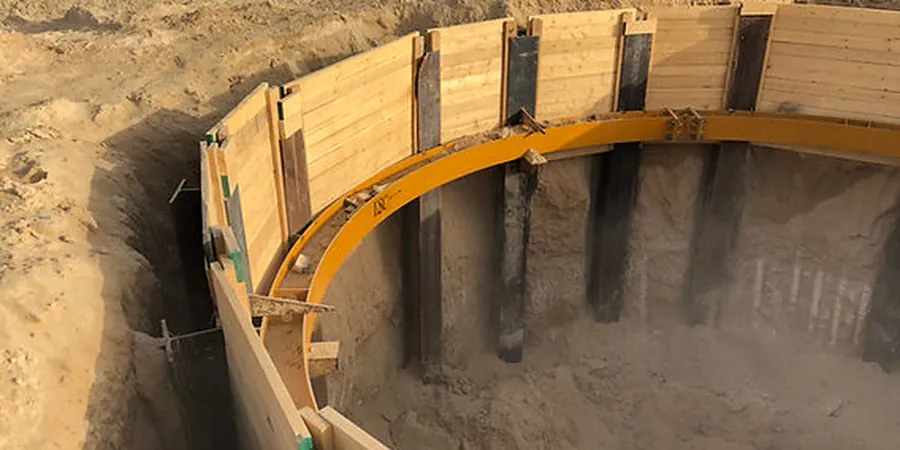
Pile design in London Clay must account for heave during excavation and negative skin friction from adjacent loading. Ignoring either can double long-term settlement.
Scope of work
- Undrained shear strength (cu) from UU triaxial tests
- Angle of internal friction (φ') from CD triaxial tests
- Stiffness modulus (E') from oedometer and pressuremeter data
- Groundwater regime from standpipe piezometers
Area-specific notes
We use a 20-tonne tracked rig for bored pile installation across Central London. The rig reaches 35 m depth, enough to penetrate the Lambeth Group into the Thanet Sand. In congested sites near the Underground tunnels we opt for continuous flight auger (CFA) piles to minimise vibration. The risk of damage to existing structures is real. Every design must include a trial pile programme and maintain a factor of safety of at least 2.0 against ultimate capacity. We also monitor pore pressure dissipation during concreting to avoid necking in the clay.
Standards used
Eurocode 7 (EN 1997-1:2004), BS EN 1997-2:2007, ICE Specification for Piling (2nd edition), NHBC Standards Chapter 4.2 (residential piling)
Linked services
Ground Investigation for Pile Design
Boreholes to 40 m depth, SPT at 1.5 m intervals, undisturbed sampling with thin-wall tubes, and full laboratory suite including triaxial CU+PP, oedometer, and Atterberg limits. Delivered to BS 5930 and Eurocode 7.
Pile Load Testing & Proof Design
Static load tests (maintained load / constant rate) up to 2× working load. PDA / CAPWAP dynamic testing for driven piles. We supply certified load-settlement curves and ultimate capacity verification.
Pile Foundation Design & Specification
Structural design of pile caps, group analysis (efficiency factors), negative skin friction assessment, and settlement calculation using elastic and finite element methods. Output includes reinforcement schedules and construction notes.
Typical parameters
Q&A
What is the typical cost of a pile foundation design in London?
For a medium-rise residential project (30–60 piles) the design and testing package ranges between £1.420 and £5.680. This includes ground investigation, pile design report, and static load test supervision. The exact cost depends on pile depth, site access and the number of trial piles.
How deep do piles need to go in London Clay?
Most buildings in Central London require piles socketed 3–6 m into the London Clay or deeper into the Lambeth Group. Depths of 15–25 m are common. The target is a stratum with undrained shear strength above 100 kPa and low compressibility. We determine the exact depth from borehole logs and triaxial test results.
What is the difference between CFA and rotary bored piles?
CFA (continuous flight auger) piles are installed without casing and work well in cohesive soils like London Clay. They are faster and produce less spoil. Rotary bored piles use a temporary steel casing and can penetrate gravels, sands and chalk. They are preferred when groundwater control is critical or when large diameters (>900 mm) are required.
Do I need a pile foundation design for a basement extension in London?
Yes, if the new basement extends below the existing foundation level or if the soil has low bearing capacity. Many terraced houses in London sit on shallow strip footings. Adding a basement requires piles or underpinning to transfer loads to deeper strata. The design must also account for heave during excavation and potential damage to neighbouring party walls.