A typical rig for slope investigation in London is a tracked drilling platform that can access tight urban sites. The team sets up on-street or within a small compound. We drill boreholes and install inclinometers to monitor movement. The London Clay is stiff and overconsolidated, but it can creep over decades. Slope stabilization design in London requires an understanding of both short-term undrained and long-term drained conditions. Each design must consider pore water pressure changes after excavation or heavy rain. We model the soil profile using data from nearby boreholes and site-specific testing. Before the analysis, we often run a MASW Vs30 survey to map stiffness contrasts across the site. This gives a quick picture of layering without invasive drilling.
London Clay slopes can lose 30 percent of their undrained strength over a single wet winter if drainage is not controlled.
Scope of work
Area-specific notes
In London, many times we see that old retaining walls have no drainage behind them. Water builds up and the effective stress drops. That is a common trigger for slope failures in the city. The other risk is tree roots. Large trees near a slope can dry the clay in summer and cause shrinkage cracks. Then winter rain fills those cracks and softens the clay rapidly. Slope stabilization design in London must account for both hydrogeological and biological factors. We recommend a phased investigation: walkover survey, boreholes, and long-term monitoring. Ignoring seasonal effects leads to under-designed slopes that move after a few years.
Standards used
Eurocode 7 (BS EN 1997-1:2004), BS 5930:2015 – Code of practice for ground investigations, FHWA-NHI-05-089 – Geotechnical Engineering Circular No. 7
Linked services
Slope Stability Analysis and Modelling
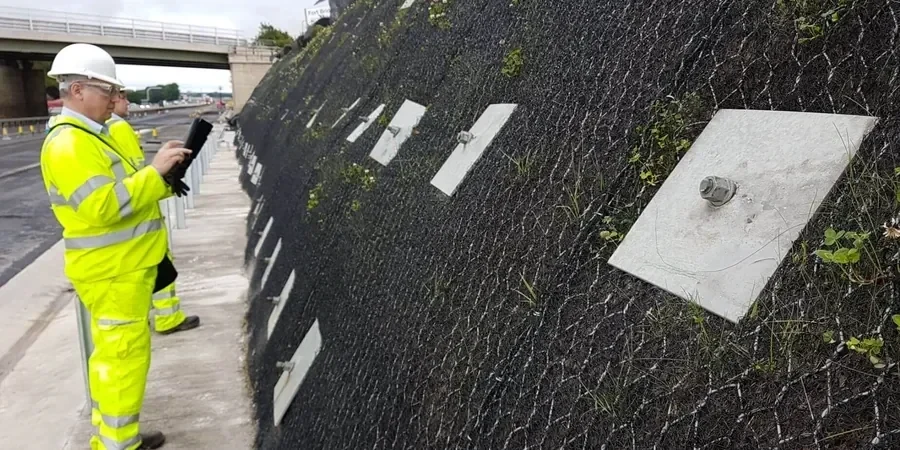
Limit equilibrium and finite element modelling using actual borehole data. We calibrate the model against inclinometer readings from the site. Output includes factor of safety, critical slip surface, and recommended reinforcement type.
Drainage and Reinforcement Design
Design of sub-horizontal drains, relief wells, or soil nails to improve stability. We size the system based on the predicted pore pressure regime. Drawings and specifications are prepared for contractor tender.
Typical parameters
Q&A
What is the typical cost range for a slope stabilization design in London?
The typical cost range for a slope stabilization design in London is between £1.290 and £5.450. This includes site visit, borehole data review, modelling, and a written report with reinforcement recommendations. The final price depends on the number of boreholes and the complexity of the slope geometry.
How long does a slope stability study take for a typical London site?
A standard study takes 4 to 6 weeks. The first week covers site walkover and borehole drilling. The second week is laboratory testing for shear strength parameters. The final weeks involve modelling, sensitivity analysis, and report writing. Complex slopes with multiple failure mechanisms may take 8 weeks.
Do I need planning permission for slope stabilization works in London?
Yes, most slope stabilization works require planning permission from the local borough council. The design report must demonstrate that the factor of safety meets Eurocode 7 requirements. We include a geotechnical design summary that engineers and planners use to assess the proposal. The report also covers temporary works stability during construction.