London sits on a deep sequence of London Clay overlying the Lambeth Group and Thanet Sand, with the water table often just 3–5 m below ground in the Thames floodplain. Sheet pile wall design in this setting must account for high lateral earth pressures and potential groundwater seepage through the gravels. Our team integrates site-specific soil parameters from boreholes and laboratory testing to produce reliable embedment depths and bending moment envelopes. Before finalising the wall section, we often cross-check assumptions with a slope stability analysis to verify global stability, and we use pore pressure dissipation data to calibrate the drained and undrained strength profiles. The result is a design that responds to London's actual ground conditions, not textbook averages.
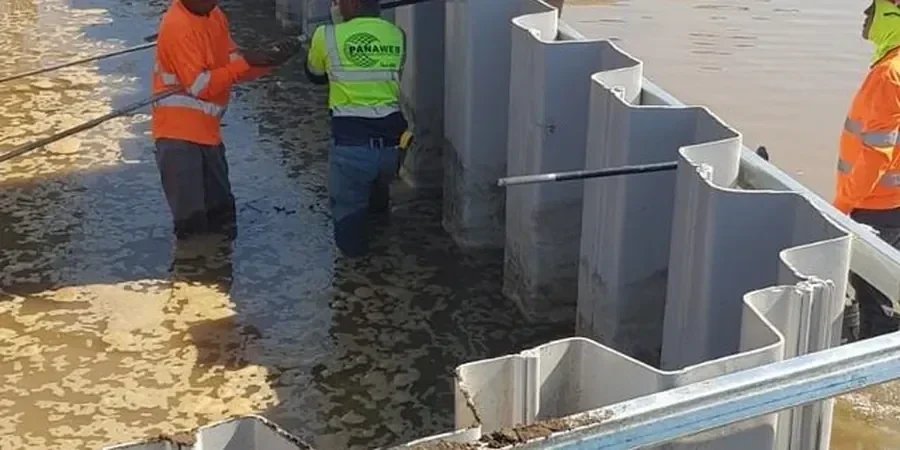
Designing sheet pile walls in London means balancing high lateral pressures from Thames gravels with tight deflection limits near existing structures.
Scope of work
- Classification of soil layers from trial pits and rotary cores
- Measurement of shear strength via triaxial and direct shear tests
- Groundwater monitoring to define seepage gradients behind the wall
Area-specific notes
A recent basement excavation near Blackfriars required a 9 m high sheet pile wall only 2 m from a listed railway viaduct. The biggest risk was excessive lateral movement during the dredge sequence. We modelled the wall in stages using a finite‑element code that accounted for the high stiffness of the London Clay and the low stiffness of the underlying gravels. A single-phase installation without pre‑augering would have caused vibrations that could damage the viaduct foundations. By specifying a silent vibratory hammer and pre‑drilling through the gravel layer, we kept peak particle velocity below 12 mm/s and maintained wall alignment within 25 mm of vertical.
Standards used
Eurocode 7 (BS EN 1997-1:2004), BS 5930:2015 — Code of practice for ground investigations, BS EN 12063:1999 — Execution of sheet pile walls, CIRIA C760 — Guidance on embedded retaining walls
Linked services
Geotechnical parameter derivation
From borehole logs and lab tests we derive characteristic values of undrained shear strength (cu), effective stress friction angle (φ′), and stiffness modulus (Eu and E′) for each soil layer. These parameters are the foundation of any sheet pile wall design.
Structural wall design & verification
Using software such as WALLAP and Oasys Frewe, we calculate embedment depth, bending moment, shear force, and deflection at each construction stage. We produce a design report with drawings that satisfy the approval requirements of the London Borough building control.
Typical parameters
Q&A
What is the typical cost for sheet pile wall design in London?
For a standard retained height of 4 m to 8 m, design fees including parameter derivation and a full limit‑state report range between £1.320 and £4.250, depending on the complexity of the ground profile and the number of construction stages modelled.
How deep do sheet piles need to be embedded in London Clay?
Embedment depth depends on the retained height, surcharge loading, and groundwater level. For a 6 m retained wall in stiff London Clay, the required penetration below dredge level is typically between 0.6H and 1.0H, where H is the retained height. We verify this with a limit‑state equilibrium check per Eurocode 7.
Can sheet piles be driven near London Underground tunnels?
Yes, but the design must include a vibration assessment and a deflection limit that protects the tunnel lining. We routinely specify silent vibratory hammers and pre‑boring through gravels to keep peak particle velocity below 15 mm/s. All designs are reviewed against TfL's asset protection standards.
What corrosion protection is required for permanent sheet piles in London?
For permanent walls in the Thames floodplain, we specify a sacrificial steel thickness of 2 mm to 3 mm on each face, based on the design life (usually 50 or 120 years). In aggressive ground conditions we also apply a coal‑tar epoxy coating to the exposed section above the water table.