We worked on a 15-storey residential tower near the South Bank where the London Clay profile was straightforward, but the overlying alluvial terrace deposits created a clear impedance contrast. That mismatch can amplify surface shaking by a factor of 1.6 or more. For that project we ran a full seismic amplification analysis using shear-wave velocity profiles from MASW surveys. The results directly informed the foundation design and saved the client from over-specifying reinforcement. Before any dynamic analysis we always cross-check with a microzonificación sísmica study to map site class variability across the footprint. London's geology is layered, and ignoring the velocity reversal between Terrace Gravel and London Clay is a common mistake.
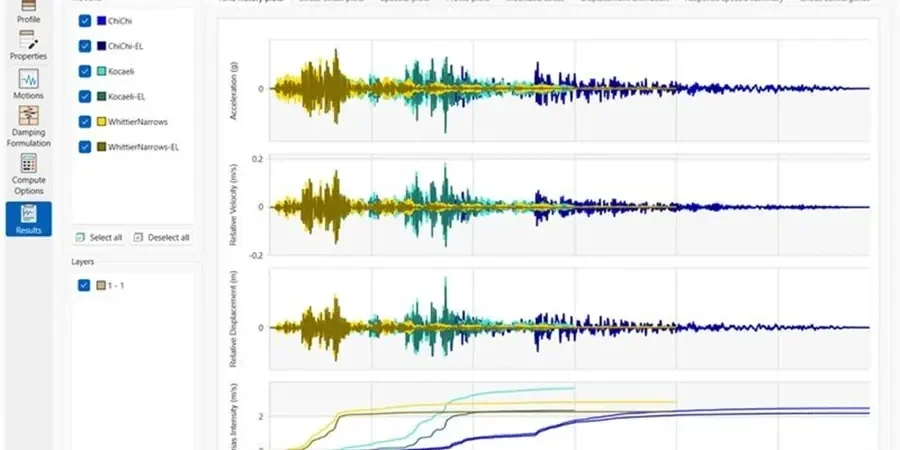
A site class mismatch between Terrace Gravel and London Clay can amplify peak ground acceleration by 60 percent — a figure no designer should ignore.
Scope of work
- Average shear-wave velocity in the top 30 m (VS30)
- Fundamental site period (T0) from HVSR measurements
- Strain-dependent modulus reduction curves (G/Gmax vs. γ)
Area-specific notes
London's geology is deceptive. The stiff London Clay underlies soft alluvium and Terrace Gravel in many central boroughs. That inverted stiffness profile creates a velocity inversion that traps shear waves and amplifies long-period motion. Buildings above 10 storeys are especially sensitive. We recently assessed a site in Islington where the amplification factor reached 1.75 in the 0.6–1.0 s period band. Without a proper seismic amplification analysis the structural engineer would have underestimated the base shear by almost 40 percent. The clay's non-linear behaviour under cyclic loading also shifts the fundamental period, so a linear code-based check alone is insufficient.
Standards used
BS EN 1998-5:2004 (Eurocode 8 – Foundations, retaining structures and geotechnical aspects), NEHRP Recommended Provisions (FEMA P-1050) – Site classification VS30 thresholds, BS 1377/D4428M-18 (Crosshole seismic testing for shear-wave velocity)
Linked services
1D Equivalent-Linear Wave Propagation Analysis
We model the soil column using measured shear-wave velocity profiles and strain-dependent modulus reduction curves. Output includes acceleration response spectra at the ground surface, amplification functions, and depth-to-bedrock effects. Suitable for low-to-moderate seismicity regions like London.
HVSR and Ambient Noise Array Measurements
Single-station HVSR (horizontal-to-vertical spectral ratio) surveys to identify the fundamental resonance frequency of the site. Combined with a small-aperture array, we resolve the VS30 profile without boreholes. Ideal for preliminary site classification and spatial variability mapping.
Typical parameters
Q&A
How does seismic amplification analysis differ from standard site classification?
Standard site classification assigns a soil class (A–E) based on VS30. Amplification analysis goes further: it computes the frequency-dependent transfer function of the soil column, accounts for non-linear strain softening, and outputs site-specific response spectra. In London, where the impedance contrast between Terrace Gravel and London Clay is sharp, the code-based class alone can underestimate the actual amplification by a factor of 1.2–1.5.
What is the typical cost range for a seismic amplification study in London?
For a standard urban project with 2–3 MASW lines and 1D equivalent-linear analysis, the cost falls between £840 and £1.700. The final price depends on the number of measurement points, the need for borehole geophysics, and the complexity of the soil profile. We supply a fixed-price quote after reviewing the site conditions.
Which London areas are most prone to significant seismic amplification?
Areas underlain by soft alluvium or peat deposits along the Thames floodplain — such as Bermondsey, Greenwich, and parts of Hackney — show the highest amplification potential (AF > 1.6). Conversely, sites directly on London Clay with minimal overburden typically amplify less (AF < 1.3). The city's basin geometry also generates a basin-edge effect that focuses energy in the 0.5–1.0 s period band.
Can amplification analysis be done without boreholes?
Yes, we routinely use surface-wave methods (MASW and ReMi) combined with HVSR to derive VS30 and depth-to-bedrock estimates without drilling. For low-rise projects in low-seismicity zones this is often sufficient. However, if the structure is critical (hospitals, schools, tall towers) we recommend at least one borehole with downhole seismic logging to validate the velocity profile.