Many construction teams in London assume that existing borehole records from adjacent sites are enough to design shallow foundations. That assumption has led to costly redesigns when unexpected made ground, old river terraces, or buried obstructions appeared during excavation. A dedicated exploratory test pit provides direct visual confirmation of soil stratification at the exact footprint of the proposed footing. It reveals features no SPT log can catch: root systems, rubble lenses, or the transition from fill to natural London Clay. For any project in the capital, skipping this step introduces uncertainty into the bearing stratum that no calculation can fully correct. Combining the test pit with a complementary ensayo spt gives a complete picture of both visual layering and penetration resistance at the same location.
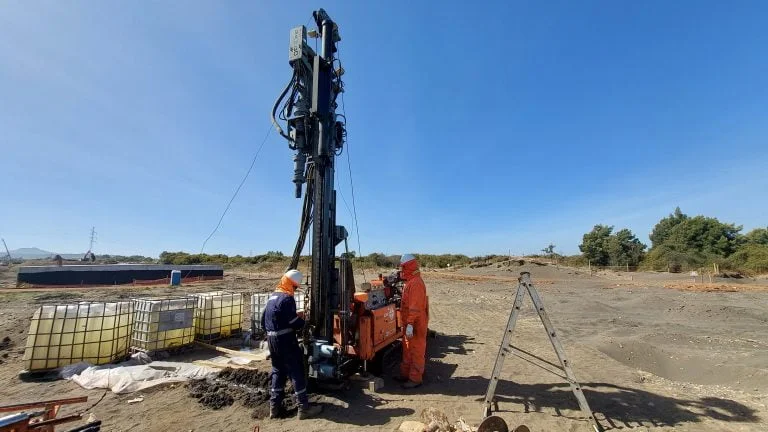
Direct visual logging of the bearing stratum eliminates the single largest unknown in shallow foundation design across London's variable geology.
Scope of work
Area-specific notes
A mid-rise residential project in Hackney relied solely on archival boreholes for foundation design. During excavation for the lift pit, the contractor hit a buried timber wharf structure from the 19th century — completely absent from the published geology. The delay and redesign cost three weeks and significant remedial piling. A single exploratory test pit in London, dug during the site investigation phase, would have revealed the obstruction before the foundation design was finalised. Ignoring the variability of urban fill and historical infrastructure is the most common source of cost overrun in London groundworks.
Standards used
BS 5930:2015 + A1:2020 – Code of practice for ground investigations, Eurocode 7 – Geotechnical design (EN 1997-1:2004), BS EN 1997-2:2007 – Ground investigation and testing
Linked services
Shored Test Pit Excavation
Manual or machine excavation with hydraulic shoring to BS 5975, ensuring safe access for the logging engineer. Depths up to 4.0 m in stable ground, with continuous visual logging per BS 5930.
In-Situ Penetration Testing
After logging, we can perform a hand-held dynamic probe or shear vane test within the pit base to obtain immediate strength parameters. This complements the visual record with quantitative data.
Disturbed Sampling & Laboratory Index Tests
Bulk samples from each distinct layer are sealed, labelled, and transported to our UKAS-accredited laboratory for moisture content, Atterberg limits, and particle size distribution, providing the index properties needed for classification.
Typical parameters
Q&A
How deep can an exploratory test pit go in London?
In typical London conditions, a shored test pit reaches 2.5 to 3.0 m safely. With wider benching or trench sheets, depths of 4.0 m are possible in stable Terrace Gravels or firm London Clay. Groundwater or running sands limit the practical depth.
What is the difference between a test pit and a borehole for foundation design?
A test pit gives direct visual exposure of the soil profile, allowing the engineer to see stratification, voids, roots, and obstructions that a borehole log only infers. Boreholes supply continuous penetration resistance but miss lateral variations. We often recommend both for critical structures.
How much does an exploratory test pit cost in London?
The typical cost for a single shored test pit with logging and disturbed sampling ranges from £430 to £610, depending on depth, access constraints, and the need for traffic management. Volume discounts apply for multiple pits on the same site.
Can a test pit be used to classify soil for bearing capacity under Eurocode 7?
Yes. The visual logging and bulk sampling from a test pit supply the foundation for soil classification and index properties. These feed directly into the characteristic values used in Eurocode 7 design. For fine-grained soils, the moisture content and plasticity indices from the lab are essential.