Ground improvement in London is a critical geotechnical discipline that transforms weak, compressible, or otherwise unsuitable ground into stable, load-bearing strata capable of supporting modern infrastructure. The capital's dense urban fabric, combined with a legacy of industrial use and complex subsurface conditions, means that building on untreated ground is rarely a viable option. This category encompasses a range of advanced techniques—from mechanical methods like vibrocompaction design to chemical processes such as lime and cement stabilization—each engineered to mitigate settlement, increase bearing capacity, and manage groundwater. For developers and engineers, selecting the right improvement strategy is not merely a technical decision; it is a fundamental risk-management exercise that dictates project feasibility, programme, and long-term asset performance.
The geological context of London is dominated by the London Basin, a syncline of Cretaceous and Palaeogene strata overlying a deep chalk aquifer. Near the surface, the London Clay Formation exerts the greatest influence on ground improvement needs. This stiff, overconsolidated clay can be extremely competent when dry but is notoriously prone to swelling and shrinkage with seasonal moisture changes, leading to significant ground movement. Overlying this are extensive, highly variable Quaternary deposits, including layers of soft alluvium, river terrace sands and gravels, and pockets of peat and organic silts along the Thames and its buried tributaries. These superficial deposits often present low bearing capacities and high compressibility, making techniques like stone column design essential for supporting shallow foundations on large-scale residential and commercial developments.
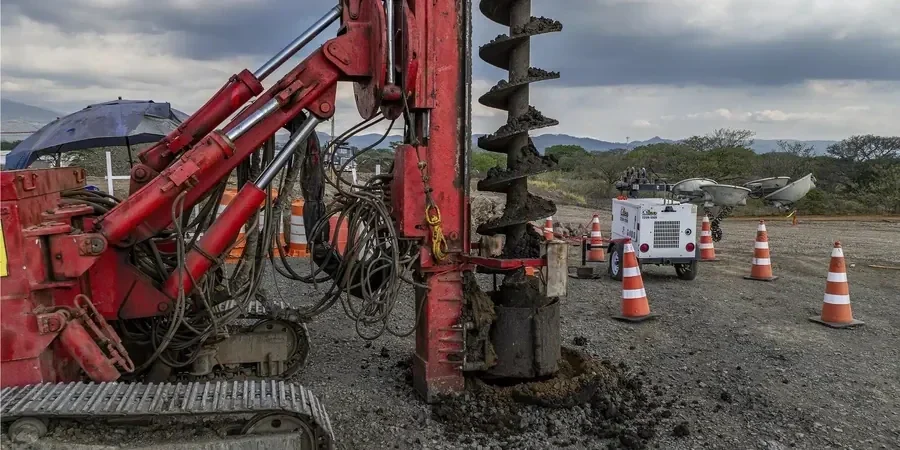
The regulatory framework for ground improvement in the UK is robust and driven by safety and environmental accountability. The core standard is BS EN 1997-1:2004+A1:2013 (Eurocode 7: Geotechnical design), which must be applied alongside its UK National Annex, retaining key aspects of the withdrawn BS 8004 for foundation design. Execution of improvement works is governed by BS EN 14475 on the execution of special geotechnical works, with specific parts covering deep mixing, vibrocompaction, and stone columns. Crucially, the land contamination regime under Part 2A of the Environmental Protection Act 1990 and the National Planning Policy Framework (NPPF) makes a thorough contaminated land risk assessment mandatory. This directly links ground improvement with contaminated soil remediation, as a single site often requires both stabilisation and remediation, demanding an integrated design approach approved by the local authority and the Environment Agency.
The types of projects demanding ground improvement across London are diverse. Large-scale residential masterplans on former industrial land in the Lea Valley or Thames Gateway routinely require deep soil mixing or stone columns to support multi-storey structures on weak alluvium. Infrastructure projects, such as the expansion of transport hubs or the construction of deep shafts for the Thames Tideway Tunnel, have relied heavily on Deep Soil Mixing (DSM) design to create stiff retaining walls and base plugs below the water table. Commercial developments in the City and Canary Wharf, where basements push deep into the water-bearing sands and gravels, necessitate sophisticated geotechnical drainage design and dewatering strategies to facilitate safe excavation. Even the refurbishment of historic structures, where vibration-sensitive assets preclude dynamic compaction, calls for specialist grouting or mixing techniques to underpin and stabilise without causing damage.
Quick answers
What are the main objectives of ground improvement in London?
The primary objectives are to increase bearing capacity, reduce total and differential settlement, accelerate consolidation of soft clays, and mitigate liquefaction potential in loose sands. In London, a critical additional goal is to manage the shrink-swell behaviour of the London Clay, which can cause significant damage to lightly loaded foundations. Improvement also facilitates safe excavation by controlling groundwater through cut-off walls or drainage.
How do I choose between different ground improvement techniques for a London site?
Technique selection depends on a detailed ground investigation, structural loading requirements, and site constraints. For deep, soft alluvium, stone columns or deep soil mixing may be suitable, while vibrocompaction is ideal for loose granular fills. Contaminated sites often require solidification/stabilisation methods that combine remediation with strength gain. Key factors include depth of treatment, sensitivity of adjacent structures, available headroom, and the required settlement performance.
What are the key regulatory requirements for ground improvement works in the UK?
All ground improvement must be designed in accordance with Eurocode 7 (BS EN 1997-1) and executed following BS EN 14475. A robust site investigation to BS EN 1997-2 is mandatory to define the ground model. Where contamination is present, compliance with the Environmental Protection Act 1990 and an agreed remediation strategy from the local planning authority are required. Works affecting groundwater may also need an abstraction or impoundment licence from the Environment Agency.
Can ground improvement be combined with contaminated soil remediation on the same project?
Yes, this integrated approach is highly efficient and common on London's brownfield sites. Techniques like deep soil mixing and lime-cement stabilisation can simultaneously immobilise heavy metals or organic contaminants while improving the soil's engineering properties. This dual-purpose solution reduces the need for off-site disposal of contaminated material and provides a stable, safe platform for construction, but it requires a comprehensive design validation through laboratory treatability studies and in-situ verification.