A common mistake on London sites is pouring concrete directly onto untreated clay. The London Clay formation, which underlies most of the city, has high plasticity and low bearing capacity when wet. Without chemical treatment, slabs crack, roads settle, and retaining walls tilt within months. Lime and cement stabilization modifies the soil at the molecular level, reducing plasticity index and increasing California Bearing Ratio (CBR) values from around 2% to over 15%. This process turns a problematic clay into a reliable subgrade, saving weeks of excavation and replacement. For projects near the River Thames floodplain, where groundwater is shallow, combining stabilization with a drainage geotechnical study ensures the treated layer stays dry during curing. The team designs the binder dosage based on site-specific Atterberg limits and pycnometer tests, not generic recipes.
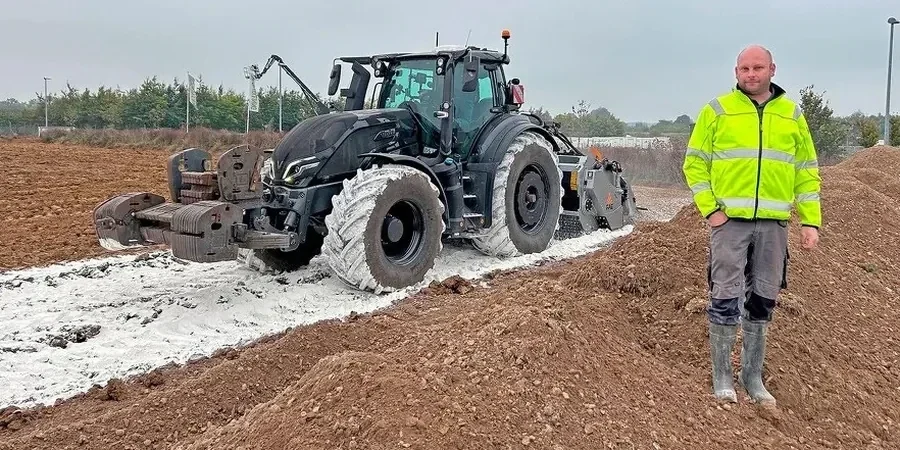
Lime pre-treatment on wet London Clay can raise CBR from 2% to 12% before cement even touches the soil, cutting project costs by up to 30%.
Scope of work
- Plasticity Index (PI) — target reduction from >45% to <20%
- Maximum Dry Density (MDD) — Proctor compaction, BS 1377-4
- Unconfined Compressive Strength (UCS) — 7-day and 28-day, BS 1924-2
- California Bearing Ratio (CBR) — soaked and unsoaked, BS 1924-2
- pH and Sulphate Content — to avoid ettringite formation
Area-specific notes
In London, we often see contractors skip the mix design phase and order a standard 5% cement dose. That is a gamble. On a recent residential development in Camden, the untreated clay swelled after a wet winter, lifting a ground-floor slab by 40 mm. The fix involved breaking out the concrete, treating the subgrade with lime-cement at 8% total binder, and reinstating. That retrofit cost three times the original stabilisation budget. The risk is not just swelling — sulphate attack from pyrite in the London Clay can destroy cement-bound layers within two years. A proper site investigation includes pH and sulphate testing before any binder selection. Without it, you are building on a ticking clock.
Standards used
BS 1924-2:2018 — Stabilised materials for civil engineering, BS 5930:2015 — Code of practice for site investigations, BS 1377 — Evaluating effectiveness of chemical admixtures, Eurocode 7 — EN 1997-1:2004 (geotechnical design)
Linked services
Lime pre-treatment for wet London Clay
Quicklime or hydrated lime mixed in-situ to reduce moisture content by 3–6%, lower plasticity, and create a workable platform. Curing time: 24–48 hours before cement application. Ideal for alluvial deposits near the Lea Valley.
Cement stabilisation for bearing platforms
Portland cement blended at 4–8% by dry weight to achieve UCS of 1.0–2.0 MPa and CBR > 15%. Used under road bases, slab-on-grade, and shallow foundations. Mix design verified by 7- and 28-day UCS tests.
Lime-cement combined treatment for high-PI clays
Two-stage process: lime first (1–3%) to modify plasticity, then cement (4–6%) for strength gain. Suitable for London Clay with PI > 45% or where sulphate content is borderline. Full chemical analysis included.
Typical parameters
Q&A
How long does lime and cement stabilisation take to cure in London's climate?
Lime pre-treatment typically cures in 24–48 hours depending on ambient temperature and wind. Cement stabilisation reaches 70% of its 28-day strength within 7 days. In London's mild, humid climate, we recommend a minimum 7-day curing period before trafficking, with light watering to prevent surface drying cracks.
What is the cost range for lime and cement stabilisation in London?
The cost ranges between £630 and £1,940 per project, depending on area treated, binder dosage, and whether lime pre-treatment is needed. This includes site sampling, mix design, and UKAS-accredited lab testing. Bulk treatment of large sites reduces the per-tonne cost.
Can stabilisation handle sulphates in London Clay?
Yes, but only if the sulphate content is below 1.5% (as SO₃) for cement stabilisation. If levels are higher, we use a lime-only treatment or a sulphate-resisting cement. A pH and sulphate test is mandatory before any binder selection — we run this in-house following BS 1377-3.