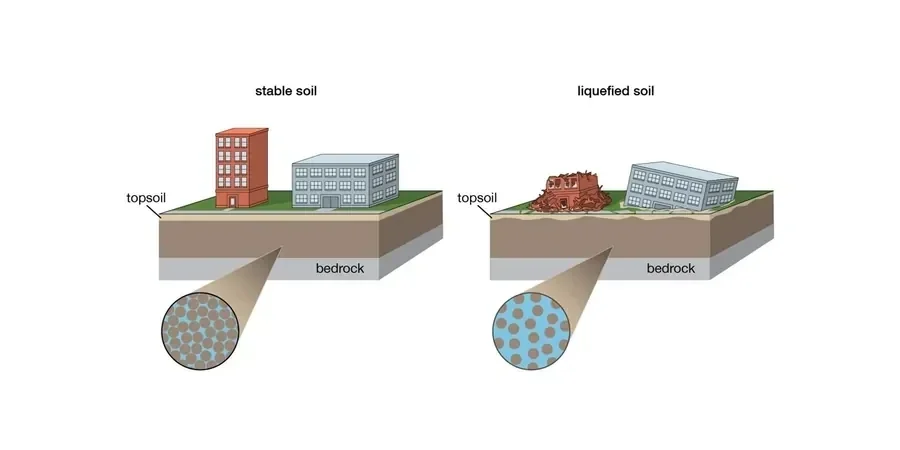
The geology beneath London presents a particular challenge for soil liquefaction analysis. The Thames Basin is underlain by London Clay, a stiff overconsolidated clay that typically resists liquefaction, but above it lie river terrace deposits—sands and gravels with high groundwater tables. In places like the Isle of Dogs or along the Lea Valley, the water table sits less than 3 metres below surface. When a seismic event occurs, those loose saturated sands can lose strength abruptly. We have seen that a proper liquefaction analysis in London must start with the SPT-based method from Youd and Idriss (2001), complemented by the MASW-Vs30 survey to capture shear-wave velocity profiles across the site.
In the Thames alluvium, a fines content above 15% can raise the cyclic resistance ratio by 30%, shifting the site from 'liquefiable' to 'non-liquefiable' under the same seismic load.
Scope of work
Area-specific notes
Picture a 10-storey residential block being built on the site of a former gasworks in east London. The foundation design assumed end-bearing piles on the London Clay, ignoring the 6 metres of loose sands and gravels above. During a moderate earthquake—say Mw 5.5 centred near the Thames Estuary—those sands could liquefy, causing the piles to lose lateral support and the building to tilt. We have investigated similar cases in the Docklands area where differential settlements of 150–200 mm occurred after minor seismic shaking. A soil liquefaction analysis in London is not theoretical; it prevents real structural distress that can cost millions in remediation.
Watch how it works
Standards used
Eurocode 7 (EN 1997-1:2004) – Geotechnical design, BS EN 1998-5:2004 – Seismic design of foundations and retaining structures, Youd & Idriss (2001) – NCEER Summary Report on Liquefaction (adopted by NEHRP)
Linked services
SPT-Based Liquefaction Assessment
Standard Penetration Test soundings in granular layers with energy correction to (N1)60,cs. We apply the Youd-Idriss triggering curves and compute factor of safety per layer.
Cyclic Triaxial Testing (BS 1377)
Undisturbed samples of sand and silt are subjected to cyclic loading at frequencies of 0.1–1 Hz to measure pore pressure generation and cyclic strength.
Shear-Wave Velocity Profiling (MASW)
Multichannel Analysis of Surface Waves to obtain Vs30 and classify the site per ASCE 7 and Eurocode 8. Essential for estimating site amplification and liquefaction potential.
Liquefaction Hazard Mapping
GIS-based mapping of liquefaction susceptibility across your site, integrating borehole data, water table contours, and seismic hazard curves from UK National Seismic Hazard Map.
Typical parameters
Q&A
What is soil liquefaction and why should I worry about it in London?
Soil liquefaction occurs when loose, saturated sandy soils lose their effective stress during cyclic loading, behaving like a liquid. In London, the risk is concentrated in areas underlain by Holocene alluvium, river terrace deposits, and Made Ground along the Thames and its tributaries. Even though UK seismicity is low to moderate, a PGA of 0.10–0.15 g is enough to trigger liquefaction in loose sands with a high water table.
How much does a soil liquefaction analysis in London cost?
For a typical residential or commercial site in London, a complete liquefaction analysis including SPT soundings, laboratory cyclic triaxial tests, and a numerical assessment falls between £1,960 and £3,240. The final cost depends on the number of boreholes, the depth of investigation, and whether shear-wave velocity profiling is required.
Which method does your team use to evaluate liquefaction triggering?
Our primary method is the NCEER procedure from Youd & Idriss (2001), which uses corrected SPT blow counts and the cyclic stress ratio. For sites where SPT data is limited, we also apply the Vs-based method using MASW profiles. Both approaches are calibrated with laboratory cyclic triaxial tests on undisturbed samples to confirm the cyclic resistance ratio.
Can liquefaction occur in London Clay?
No. London Clay is a highly overconsolidated clay with a plasticity index typically above 30% and an undrained shear strength greater than 100 kPa. It does not liquefy because its fine-grained nature prevents the rapid pore pressure buildup needed for liquefaction. The risk is confined to the overlying river terrace sands, alluvium, and loose fill materials.