London sits on a thick sequence of London Clay, a stiff overconsolidated clay that reaches depths of over 100 metres in the central area. Above it, variable layers of River Terrace Gravels and made ground present a real challenge for foundation engineers. The Standard Penetration Test (SPT) remains the most widely used in-situ method to profile these deposits, providing N-values that correlate directly with shear strength and compressibility. Before designing deep foundations, a reliable SPT campaign is essential. For shallow solutions, we often recommend combining the SPT with a placa de carga to validate bearing capacity at formation level.
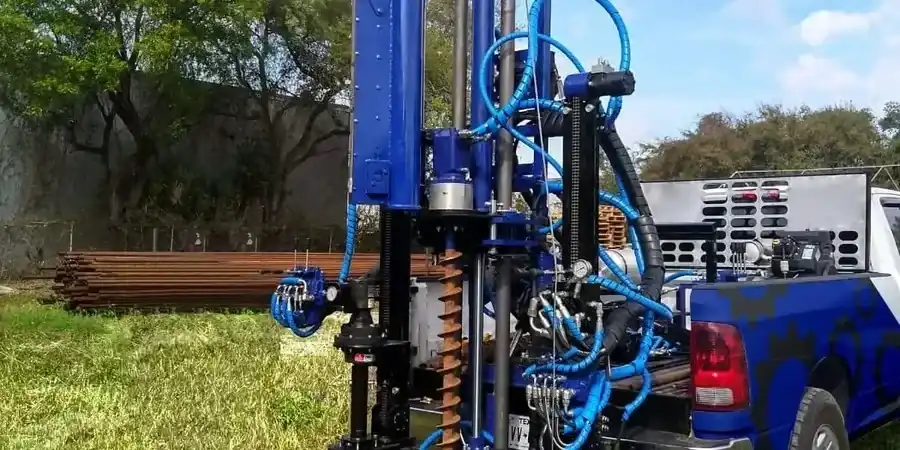
London Clay can exhibit N-values from 25 to over 60 in its stiff zone — ignoring these variations leads to costly foundation overdesign or, worse, differential settlement.
Scope of work
Area-specific notes
In London, one of the most overlooked risks is the presence of silt or sand partings within the London Clay. These thin layers can drain rapidly during SPT driving, producing artificially high N-values that suggest a stiffer deposit than actually exists. Similarly, in the River Terrace Gravels, cobbles or flints can jam the split spoon, giving blow counts that reflect obstruction rather than soil strength. Our engineers review every test record for these anomalies, and we flag any erratic profile immediately. We also apply energy corrections per Seed et al. (1985) to normalise results across different rigs.
Standards used
BS EN ISO 22476-3:2005 – Field testing (SPT), BS 5930:2015 – Code of practice for ground investigations, Eurocode 7 – EN 1997-2:2007 (geotechnical design)
Linked services
SPT in London Clay
Full-profile SPT logging in stiff clay to assess undrained shear strength and settlement behaviour. Continuous sampling with SPT liners for moisture content and Atterberg limits.
SPT in River Terrace Gravels
Adapted drilling techniques using casing and water flush to prevent borehole collapse. N-values corrected for energy and overburden to derive relative density and friction angle.
Seismic SPT (SPT-VS)
Downhole shear-wave velocity measurement combined with SPT at the same depth. Provides Vs30 profiles for seismic site classification per Eurocode 8, essential for London's moderate seismicity.
SPT for Pile Design
High-resolution SPT profiles at 0.5 m intervals near pile locations. Correlated with CPT data to estimate shaft friction and end-bearing capacity in London Clay and Thanet Sand.
Typical parameters
Q&A
How much does an SPT test cost in London?
A typical SPT in London ranges from £440 to £560 per test point, depending on depth, access, and whether continuous sampling is required. Bulk campaigns or multi-borehole projects often receive a reduced rate.
What is the difference between SPT N-value and undrained shear strength in London Clay?
The N-value is a blow count that correlates empirically to undrained shear strength (cu). For London Clay, a common correlation is cu ≈ 4.5 × N (kPa) for stiff clays, but site-specific calibration with triaxial tests is always recommended due to the clay's variable fissuring and silt content.
Can SPT be performed in made ground or fill?
Yes, but with caution. Made ground in London often contains rubble, concrete fragments, or timber, which can damage the split spoon or produce erratic blow counts. We pre-drill through obstructions with a rock roller and only perform SPT in continuous soil layers. Results are flagged if fill is present.