London expanded rapidly during the Victorian era, pushing construction onto the steeper valley sides of the Thames and its tributaries. Those slopes, cut into London Clay and the underlying Lambeth Group, have been sliding for centuries. In our background, the legacy of uncontrolled fill and old retaining walls makes modern slope stability analysis essential before any cut or excavation. We combine limit-equilibrium models with site-specific shear-strength data from consolidated-undrained triaxial tests. A typical project starts with walkover survey and boreholes, then we run Spencer’s method for non-circular slip surfaces. For shallow failures we often find a test pit inspection gives the fastest look at the slip plane geometry.
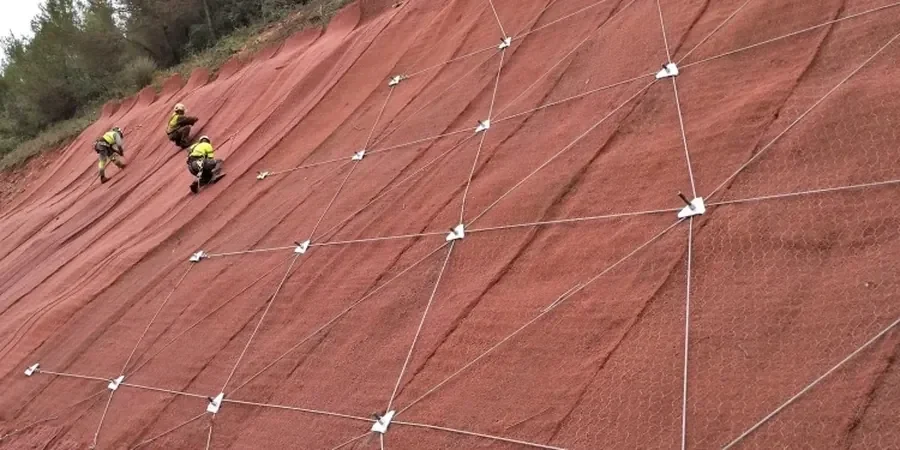
Most London landslides are translational slides in weathered London Clay, triggered by winter groundwater rise – a pattern we see every year.
Scope of work
Area-specific notes
Eurocode 7 (EN 1997-1:2004) requires that slope stability be verified for ultimate and serviceability limit states. In London this is especially relevant because the clay’s undrained strength can drop by 40% over the winter months. We have seen cases where a temporary slope stood stable for weeks then failed overnight after a heavy rain. The risks are not limited to deep cuts: shallow fill slopes on the Lea Valley have caused damage to railway embankments. Our reports always include a sensitivity analysis on groundwater level, because that is the one variable that changes fastest on a London site.
Standards used
Eurocode 7 (EN 1997-1:2004) – Geotechnical design, BS 6031:2009 – Code of practice for earthworks, FHWA-NHI-05-039 – Slope stability reference manual, BS 1377:1990 – Methods of test for soils for civil engineering purposes
Linked services
Desktop Study & Preliminary Assessment
A desk-based review of historical maps, aerial photos, BGS borehole records and LiDAR data to identify potential failure zones. We produce a slope hazard map and recommend further investigation points. This is often sufficient for planning applications or early feasibility studies.
Detailed Stability Analysis & Design
Full geotechnical model including laboratory triaxial testing, groundwater monitoring and limit-equilibrium or finite-element analysis. We deliver a design report with recommended geometry, drainage measures and reinforcement options such as soil nails or anchored walls. Suitable for construction-stage design and temporary works.
Typical parameters
Q&A
How much does a slope stability analysis cost in London?
For a typical residential or small commercial site, the cost ranges between £970 and £3,140 depending on the number of sections analysed and whether laboratory testing is required. Larger infrastructure projects with multiple scenarios and FEM modelling fall at the upper end.
What is the difference between Bishop and Spencer methods?
Bishop's simplified method assumes circular slip surfaces and satisfies moment equilibrium only, which works well for homogeneous clay slopes. Spencer's method handles non-circular surfaces and satisfies both force and moment equilibrium, making it better for layered London Clay sites where bedding planes control the failure geometry.
Do I need a slope stability study for a basement excavation in London?
Yes, if the excavation is deeper than 2 m or within 10 m of an existing slope or river embankment. Temporary works designs often require a stability check for the unsupported cut phase. The London Boroughs routinely ask for this in planning conditions, and ignoring it can lead to enforcement notices.