The difference between a site in Kensington and one in Canary Wharf isn’t just the postcode — it’s the ground. London’s geology is dominated by the London Clay Formation, but its stiffness varies dramatically across the city. In the west, you find firmer, heavily overconsolidated clay; near the Thames, softer alluvial deposits dominate. Before we design deep foundations or assess excavation stability, we run a Ménard pressuremeter test (PMT) in London to capture that stiffness profile in-situ. Unlike SPT or CPT, the PMT directly measures the soil’s deformation modulus and limit pressure — critical values when you’re working with a tall building in the City or a basement in Southwark. We complement this with a estudio de mecánica de suelos to cross-check index properties and a ensayo de penetración SPT for stratigraphic correlation.
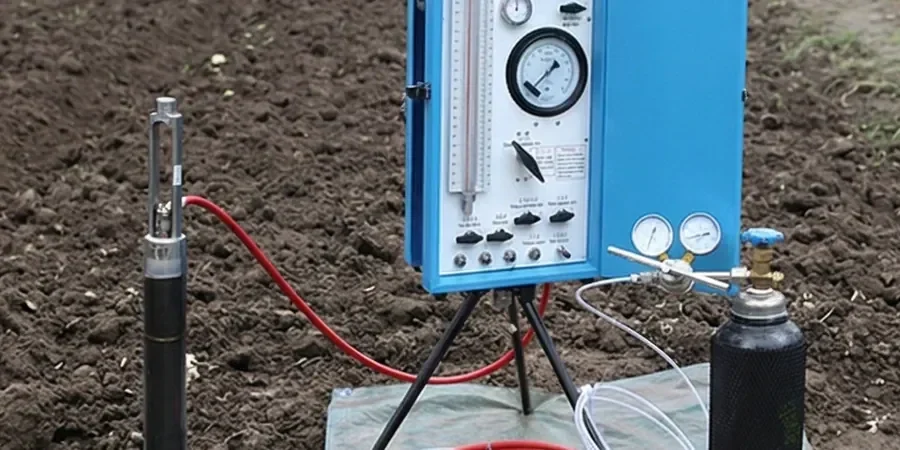
The PMT measures soil stiffness directly in-situ — no correlation, no correction factor. For London Clay, that’s the difference between a safe foundation and an expensive overdesign.
Scope of work
Area-specific notes
The Ménard pressuremeter probe is a rugged, inflatable cylinder about 60 mm in diameter. In London, we deploy it through a rotary-drilled borehole, usually with a hydraulic packer assembly. The biggest operational risk here is borehole collapse in the sandy Thanet Sand or Lambeth Group beds — that can jam the probe or give false readings. We mitigate that by using bentonite-mud drilling and casing the hole before testing. Another challenge is the presence of buried foundations or piles, common in central London, which can block the test depth. We review historical borehole logs and utility records before mobilising, and we always run a calicata exploratoria nearby to confirm the stratigraphy. If the ground is too soft, we switch to a thinner probe. It’s methodical work, but the data is worth it.
Watch how it works
Standards used
BS 5930:2015 – Code of practice for ground investigations, Eurocode 7 – EN 1997-1:2004 – Geotechnical design (limit state), BS 1377 – Standard test method for prebored pressuremeter testing in soils
Linked services
Standard PMT for Foundation Design
Full pressuremeter test at 1 m intervals from 1 m to 30 m depth. Includes data reduction, pressuremeter curve interpretation, and a geotechnical report with E_M, p_l, and p_f values. Suitable for pad, raft, and pile foundation design in London Clay and Lambeth Group.
Advanced PMT with Creep & Consolidation Analysis
Extended hold phases at each pressure step to measure creep behaviour. Combined with laboratory triaxial tests to calibrate long-term settlement models. Ideal for high-rise buildings, deep basements, and tunnels where time-dependent deformation matters.
Typical parameters
Q&A
What is the difference between a PMT and an SPT in London Clay?
The SPT gives you a blow count (N-value) that you correlate to strength and density — it’s an indirect measure. The PMT measures soil stiffness and limit pressure directly, in-situ, without empirical correlations. For London Clay, the PMT is far more reliable for estimating modulus (E_M) and lateral resistance, especially for deep foundations and retaining walls. The SPT is better for stratigraphy and relative density in sands.
How much does a Ménard pressuremeter test cost in London?
A standard PMT campaign in London typically ranges from £950 to £890 per test point, depending on depth, access, and number of tests. Mobilisation and reporting are extra. For a typical 10-test profile on a residential site, you’re looking at roughly £8,500–£11,000 all-in. Contact us for a site-specific quote.
At what depth do you usually test in London?
We test from 1 m down to 40 m, depending on the project. For shallow foundations in London Clay, we focus on the top 10–15 m. For deep piles or underpasses, we go deeper into the Lambeth Group or Thanet Sand, often to 25–30 m. The test spacing is typically 1 m in the critical zone, then 2 m below that.