London's urban expansion since the Victorian era has placed enormous demand on its road network. The city's underlying geology — primarily London Clay overlain by River Terrace Deposits — creates unique challenges for pavement longevity. We perform existing pavement evaluation to assess structural capacity and surface condition on both local roads and major arterial routes. Our team has conducted assessments across the M25 corridor and within central London's historic streets. Before any rehabilitation or overlay design, we recommend a geotechnical site investigation to understand subgrade variability. This baseline data is critical for accurate pavement life predictions in London's variable ground conditions.
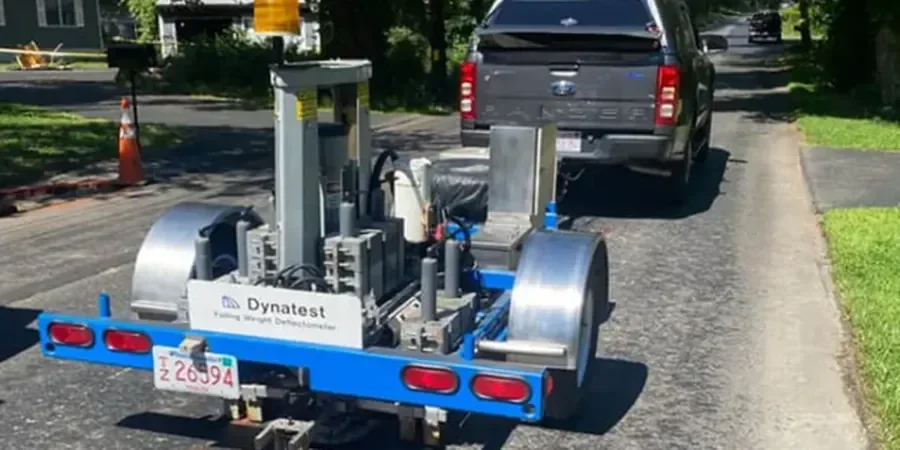
London Clay subgrades retain moisture year-round, causing seasonal stiffness changes that must be quantified for any pavement rehabilitation design.
Scope of work
- Pavement layer thickness (asphalt, base, subbase)
- Surface deflection under standard load (FWD)
- Rutting depth and crack density
- Subgrade moisture content and plasticity
Area-specific notes
We use a trailer-mounted FWD system with a 300 mm diameter loading plate. The drop weight produces a 40 kN impulse force simulating a standard truck axle. In London's narrow residential streets, we position the trailer carefully to avoid disturbing traffic flow. The risk of damaging existing utilities is low because the load is dynamic and brief. However, in areas with shallow buried solutions, we pre-mark all known utility lines before testing. For heavily cracked pavements, we also perform core extraction with a diamond-tipped barrel to assess interlayer bonding. Missing bond between asphalt lifts leads to premature fatigue failure.
Standards used
BS EN 1997-2:2007 (Ground investigation and testing), BS 5930:2015 (Code of practice for site investigations), BS 1377 (Standard test method for deflections with FWD), TRL Report 176 (Pavement evaluation in the UK)
Linked services
Structural Condition Survey
Visual assessment of cracking, rutting, and surface defects. We measure crack density and classify damage using the UKPMS system. Includes photographic log and defect mapping.
Falling Weight Deflectometer (FWD) Testing
Trailer-mounted FWD with GPS positioning. We apply a 40 kN load at 7 geophone offsets. Output includes deflection basin parameters and back-calculated layer moduli.
Core Sampling & Laboratory Testing
Coring through asphalt and base layers. We measure layer thickness, binder content, and aggregate gradation. Subgrade samples undergo CBR, Atterberg limits, and moisture content determination.
Typical parameters
Q&A
What does an existing pavement evaluation include?
It includes a visual condition survey, deflection testing with FWD, core sampling for layer thickness and material properties, and laboratory tests on subgrade samples. The output is a structural capacity report and overlay design recommendations.
How much does a pavement evaluation cost in London?
The typical cost ranges from £950 to £3,070 depending on site size, number of cores, and access constraints. We supply a fixed-price quote after a brief site visit.
Do you work on private roads and car parks?
Yes. We evaluate pavements for private estates, retail car parks, and industrial yards. The same FWD and coring methods apply. Access restrictions are handled during the site walkover.
How long does a typical evaluation take?
A standard urban road section (up to 500 m) can be surveyed in one day. Coring and laboratory testing add 5–7 working days. Full report delivery within 10 working days from site completion.
What if the pavement has buried services?
We obtain utility drawings and mark all known solutions before testing. FWD loading is dynamic and low-risk, but we avoid testing directly over critical mains. Cores are taken only after utility clearance.