London's geology is more variable than many assume. The London Clay, Lambeth Group, and River Terrace Deposits create a layered sequence where pore pressure regimes shift abruptly, especially after prolonged rainfall. We've seen cut slopes in Hampstead Heath fail along pre-existing shear surfaces, and embankments along the M25 soften due to undrained loading. That's why every slope failure analysis we run starts with a detailed walkover survey and a review of historical aerial imagery. Before running limit equilibrium models, we typically recommend a calicatas exploratorias to log stratigraphy directly, and then a ensayo SPT to capture strength parameters at depth. These field data anchor the numerical back-analysis and reduce uncertainty in the factor of safety.
A 5% drop in undrained shear strength from winter rainfall can reduce a slope's factor of safety below 1.3—the threshold for redesign.
Scope of work
- Undrained shear strength (cu) from UU triaxial
- Effective stress parameters (c', φ') from CD/CU triaxial
- Unit weight and moisture content profiles
- Pore pressure ratio (ru) from piezometer data
Area-specific notes
Compare a slope in Blackheath versus one in Richmond Park. Blackheath sits on gravels over clay—infiltration is fast, and the clay surface acts as a slip plane. Richmond Park's steep valleys are cut into London Clay, and failures there are slow, deep-seated rotational slides. Both need different analysis methods. In Blackheath we use infinite slope models with perched water tables; in Richmond we run fully coupled seepage-stability analysis. The risk in London is rarely a catastrophic collapse—it's the slow, progressive movement that cracks roads and foundation walls years after construction. That's why we include long-term monitoring recommendations in every slope failure analysis report we deliver.
Watch how it works
Standards used
BS 5930:2015 Code of practice for ground investigations, Eurocode 7 – EN 1997-1:2004 Geotechnical design, FHWA-NHI-05-083 Slope stability reference manual
Linked services
Limit Equilibrium Analysis (LEM)
We model circular and non-circular failure surfaces using Bishop, Spencer, and Morgenstern-Price methods. Inputs come from lab tests on undisturbed samples taken from boreholes and trial pits. Outputs include factor of safety contours and critical slip surface identification.
Finite Element Seepage-Stability Coupling
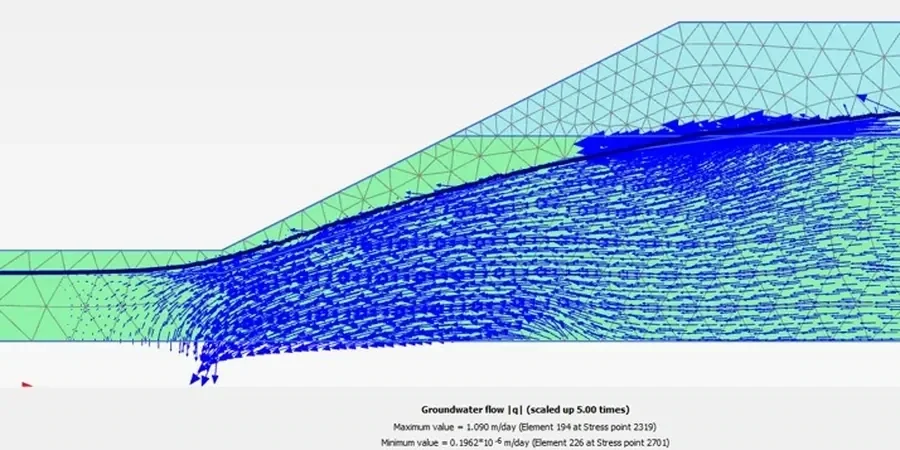
For slopes with complex stratigraphy or transient pore pressures—common in London's Terrace Gravels over Clay—we run coupled analysis in SEEP/W and SLOPE/W. This predicts how winter rainfall drives pore pressure rise and reduces stability over time.
Typical parameters
Q&A
What is the typical cost of a slope failure analysis in London?
For a standard residential project with three boreholes and laboratory testing, the cost ranges between £690 and £2,120 depending on depth, number of samples, and complexity of the failure mode. This includes field investigation, lab work, and a detailed stability report.
How long does a slope failure analysis take from start to finish?
A typical programme runs four to six weeks. Site work takes two to three days for drilling and sampling, followed by three weeks of laboratory testing and one week for modelling and reporting. We can expedite to three weeks if samples are tested in parallel.
What triggers a slope failure in London Clay?
The main trigger is prolonged winter rainfall that raises pore pressure at the base of the clay layer. Construction activities—like excavation at the toe or surcharge at the crest—also reduce the factor of safety. Pre-existing fissures and desiccation cracks act as preferential flow paths.
Do I need planning permission to conduct a slope failure analysis?
If drilling or trial pitting is on private land and no trees are affected, no formal permission is needed. However, for sites within conservation areas or near listed buildings, we advise consulting the local planning authority. We handle all necessary notifications to the council.