London's geology is famously layered: the London Clay sits atop the Lambeth Group, with Terrace Gravels near the Thames. That clay is plastic and moisture-sensitive. When we run a Proctor test on a sample from a site in Islington or Canary Wharf, we see how compaction effort changes dry density and optimum moisture. The Thames floodplain brings alluvial silts too. Each material behaves differently under the hammer. We use the Standard Proctor for fine-grained soils and the Modified Proctor for heavier loads. It is not guesswork. Before we compact anything on site, we need that curve. Combine it with a plate load test to verify achieved density against bearing capacity.
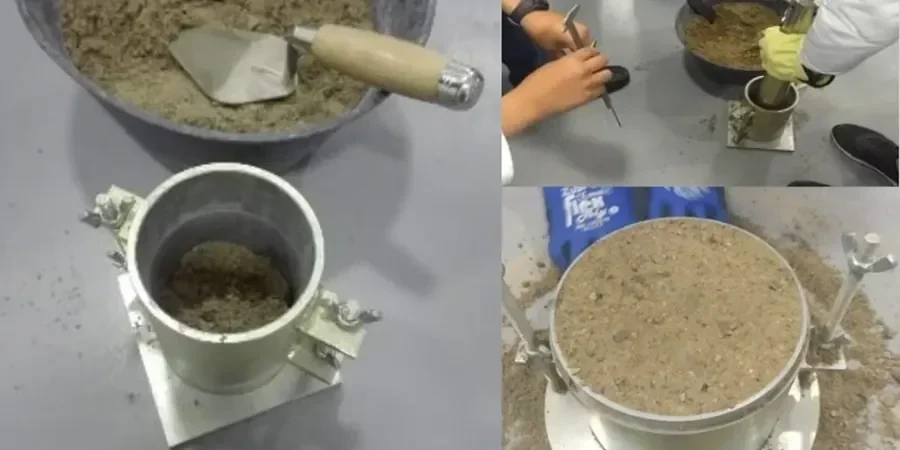
The Proctor curve is the compaction blueprint. Without it, you are compacting blind — wasting time and money on site.
Scope of work
Area-specific notes
London expanded fast in the 19th and 20th centuries. The clay was cut and filled with little compaction control. That legacy is still here. Old railway embankments, Victorian backfill, post-war land reclamation along the Lea Valley — all poorly compacted. When we drill into these fills, the Proctor test tells us if they can be recomputed or must be replaced. On new sites near the Docklands or Stratford, the risk is differential settlement. One area compacted wet, another dry. Without a Proctor curve, you cannot control that. The Modified Proctor is especially relevant for heavy infrastructure like Crossrail or HS2 cuttings.
Standards used
BS 1377-4:1990 (Methods of test for soils — Compaction-related tests), BS EN 13286-2:2010 (Unbound and hydraulically bound mixtures — Test methods for laboratory dry density and water content), BS 1377-4 (Standard Proctor), BS 1377-4 (Modified Proctor)
Linked services
Standard Proctor Test
For general fill, backfill, and trench compaction. Used when the compaction specification is less demanding. We determine optimum moisture and maximum dry density per BS 1377-4. Our technicians handle London Clay, Terrace Gravels, and made ground.
Modified Proctor Test
For road subgrades, heavy foundations, and structural fill. Higher compactive effort replicates heavy rollers on site. We report the full curve plus 95 % and 98 % relative compaction lines. Essential for projects near the Thames Gateway or large infrastructure.
Typical parameters
Q&A
What is the difference between Standard Proctor and Modified Proctor?
The main difference is compactive effort. Standard Proctor uses a 2.5 kg rammer dropped 300 mm over 3 layers. Modified uses a 4.5 kg rammer dropped 450 mm over 5 layers. Modified is about 4.5 times more energy. It is used for heavier compaction specifications like road bases and deep fills.
How much soil sample do I need for a Proctor test in London?
We need about 15 to 20 kg of disturbed soil. The sample should be representative of the material you plan to compact on site. For London Clay, we often take samples from trial pits or boreholes. Bag it in sealed plastic bags to retain natural moisture.
What is the typical cost for a Proctor test in London?
The price range is £80 to £160 per test depending on whether it is Standard or Modified and the number of points on the curve. Bulk rates apply for multiple samples from the same site. We supply a fixed quote before testing.
How long does a Proctor test take?
Turnaround is typically 3 to 5 working days from sample receipt. If you need it faster, we can prioritise for a small surcharge. We issue a PDF report with the full compaction curve, optimum moisture, and maximum dry density.