We were called to a site in Elephant & Castle last year where a 15-storey residential tower was planned over the Lambeth Group clays and Thanet Sand strata. The structural engineer needed reliable shear wave velocity data to classify the ground per Eurocode 8, not just blow counts. That's exactly where a MASW survey becomes indispensable. We deployed a 24-channel array along the Old Kent Road alignment, recording surface waves generated by a sledgehammer source. The inversion produced a clear VS30 value of 285 m/s, placing the site in class C. For deeper profiles, we combined the survey with tomographic seismic imaging to image the interface between the London Clay and the underlying sand channel.
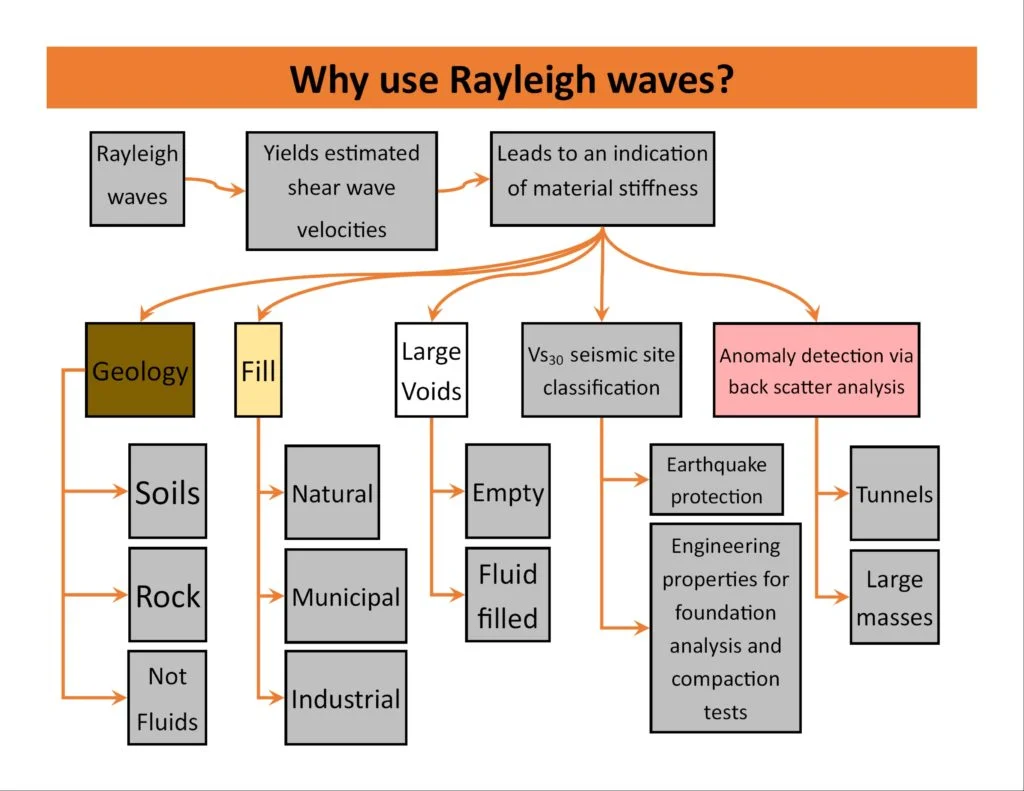
In London's Thames floodplain, a VS30 below 240 m/s pushes the site into class D, requiring full site-specific response analysis per Eurocode 8.
Scope of work
Area-specific notes
London sits on a deep sedimentary basin with the Thames River cutting through London Clay, Lambeth Group, and Thanet Sand. The water table is rarely deeper than 5 metres in central zones like Westminster or Tower Hamlets. That saturated layer strongly attenuates high-frequency surface waves, reducing resolution in the top 5 metres. We compensate by deploying a shorter 12-channel array with 0.5-metre spacing for the shallow zone, then a longer 48-channel line for the deeper profile. Without this dual-array approach, the inversion would overestimate stiffness in the critical foundation zone between 3 and 8 metres depth.
Watch how it works
Standards used
BS 1377 / D4428M-14 — Standard Test Methods for Crosshole Seismic Testing, NEHRP Recommended Provisions (FEMA P-1050) — Seismic Site Classification, Eurocode 8 (EN 1998-1:2004) — Design of structures for earthquake resistance, BS 5930:2015 — Code of practice for ground investigations
Linked services
Active-source MASW for VS30 determination
A 48-channel survey with an accelerated weight drop source, processed to extract the fundamental-mode Rayleigh wave dispersion curve. Inversion targets a depth of 30 metres to calculate VS30 per NEHRP. We deliver a site class (A to F) and a 1D shear wave velocity profile with uncertainty bounds. Ideal for tower blocks and infrastructure in central London.
Passive MASW (Refraction Microtremor) for deep profiles
For sites where the bedrock is deeper than 50 metres, such as the western suburbs around Hillingdon, we deploy a 2D array of 4.5 Hz geophones to record ambient vibrations. The SPAC method extracts dispersion data down to 100 metres. This is essential for seismic site response analysis per Eurocode 8, especially where the London Clay exceeds 40 metres thickness.
Typical parameters
Q&A
What is VS30 and why does it matter for a project in London?
VS30 is the average shear wave velocity in the top 30 metres of the ground. It is the primary parameter used by Eurocode 8 and NEHRP to classify a site into seismic class A through F. In London, the London Clay typically yields VS30 between 200 and 300 m/s, placing most sites in class C or D. That classification directly affects the design spectrum and, consequently, the lateral forces on the structure.
How does MASW compare to downhole seismic testing for VS30?
MASW is a surface-based method that does not require a borehole, so it is faster and cheaper for screening large areas. Downhole testing gives a direct measurement at discrete depths but requires a cased borehole, which adds drilling costs and time. In our London background, MASW produces a continuous velocity profile that correlates well with downhole data, provided the inversion is constrained by geological knowledge. We recommend downhole for critical structures where regulatory bodies demand direct measurement.
What is the typical cost range for a MASW survey in London?
A standard 48-channel active MASW survey for a single site, including field work, data processing, and a report with VS30 and site class, typically ranges between £1.150 and £2.590. The variation depends on site access, the number of profiles, and whether passive methods are required for deep bedrock. We supply a fixed-price quote after a site visit.
Can MASW be performed in built-up areas of London like the City or Canary Wharf?
Yes, but with constraints. The main challenge is cultural noise from underground trains, traffic, and construction. We use passive MASW (Refraction Microtremor) in those zones because ambient vibration provides a stable signal. The 2D array is deployed on pavements or in courtyards. For active-source work, we schedule the survey during night hours when traffic is minimal. We have successfully completed surveys at sites near Bank station and along the Isle of Dogs.
What standards do you follow for MASW processing and reporting?
We follow BS 1377 for acquisition and the NEHRP guidelines for VS30 calculation. The inversion is performed with a genetic algorithm that outputs a best-fit profile plus an uncertainty envelope. The final report includes the dispersion curve, the inverted velocity profile, and the site class per Eurocode 8 and BS 5930. We also supply the raw field data in SEG-2 format for independent review.