London's urban expansion over the last two centuries pushed construction onto its alluvial plains and floodplains. The Thames basin is underlain by soft alluvial soils, terrace gravels, and the London Clay formation. These variable ground conditions create real challenges for bearing capacity and settlement control. Stone column design in London emerged as a practical solution to densify soft soils without deep piling. It works by displacing weak material with compacted granular columns. This technique reduces total and differential settlements. It also mitigates liquefaction risk in loose saturated sands. Before designing stone columns we always run a geotechnical study to profile the soil stratigraphy. That baseline data determines column spacing and diameter. It also guides the selection of backfill material grade.
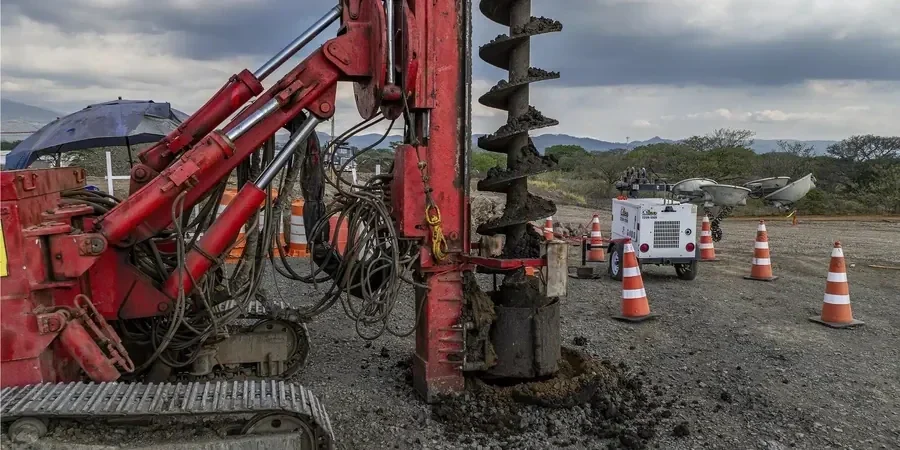
Stone columns reduce total settlement by 40 to 60 percent in soft London Clay when designed with proper replacement ratios and quality control.
Scope of work
Area-specific notes
In London, many sites have a thin crust of desiccated clay over soft alluvium. We often see projects where the crust is removed during excavation, exposing the weak layer. If stone columns are not designed with sufficient replacement ratio, the columns may buckle or punch into the soft soil. Another local risk is the presence of peat lenses within the alluvium. Peat has very low shear strength and high compressibility. Stone columns passing through peat must be designed with a gravel blanket and surcharge to mobilise lateral confinement. Without that, the columns cannot develop the required bearing capacity. We always verify the presence of peat or organic layers during the ground investigation stage.
Standards used
Eurocode 7 – Part 1 (EN 1997-1:2004) – Geotechnical design: general rules, BS EN 14731:2005 – Execution of special geotechnical works: ground treatment by deep vibration, CIRIA Report C573 – Improvement: stone columns and related techniques
Linked services
Stone Column Design and Installation
Full design-build service for stone columns in soft ground. Includes soil investigation, column layout design, material specification, installation with vibratory probe, and post-construction verification via plate load tests. Suitable for embankments, tank foundations, and low-rise buildings.
Stone Column Quality Control and Testing
Independent verification of installed stone columns. We perform in-situ column stiffness tests, zone load tests, and CPT soundings between columns. All testing follows Eurocode 7 and BS EN 14731 procedures. Results are delivered with a detailed report and as-built column log.
Typical parameters
Q&A
What is the typical cost range for stone column design and installation in London?
The typical cost range for stone column design and installation in London is £1.330 to £3.950 per project, depending on the number of columns, ground conditions, access constraints, and testing requirements. Contact our team for a detailed quote based on your site plan.
How deep can stone columns be installed in London Clay?
Stone columns can be installed to depths of up to 15 metres in London Clay using our vibratory probe rig. The effective depth depends on the rig's power, the soil stiffness profile, and the presence of obstructions such as buried gravel layers or old foundations.
What settlement reduction can I expect with stone columns under a raft foundation?
With a properly designed replacement ratio of 20 to 30 percent, stone columns typically reduce total settlement by 40 to 60 percent compared to untreated ground. Differential settlement is also significantly reduced. The exact reduction depends on the soil profile, column spacing, and applied load.