In London, the Thames Valley alluvium and the underlying London Clay create a challenging profile for deep soil mixing design. We regularly see soft, compressible deposits that require careful treatment to achieve target strengths. Our team approaches each DSM project by first characterising the ground through a combination of In-Situ like the ensayo SPT to obtain baseline N-values, and detailed laboratory classification to assess natural moisture content and organic content. These data feed directly into the binder dosage calculations and the preliminary mix design. The urban setting of London adds another layer: working near existing infrastructure means we must control ground heave and vibration, so the DSM layout and execution parameters are planned with precision from the start.
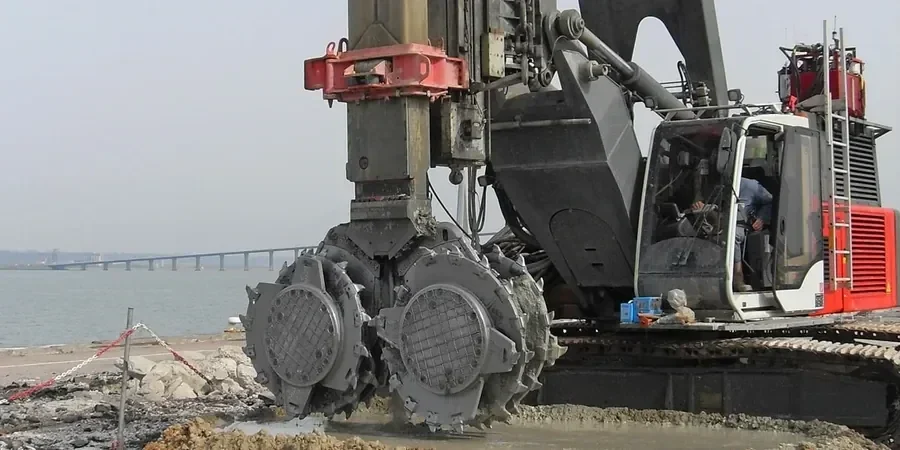
DSM design in London hinges on controlling binder content and mixing energy to treat soft alluvium and peat without overstressing adjacent structures.
Scope of work
- Mobilisation and calibration of the mixing tool
- Installation of test columns at variable binder contents (typically 150 to 400 kg/m³)
- Coring and laboratory testing after 7, 14 and 28 days
- Adjustment of the production parameters based on strength results
Area-specific notes
The biggest risk we see in London DSM projects is the variability between the alluvial deposits near the river and the more uniform London Clay further inland. In areas like the Isle of Dogs, peat layers up to 2 m thick can cause uneven treatment if the binder dosage is not adjusted on the fly. Conversely, in central London where the clay is stiff and fissured, the mixing energy must be increased to achieve full homogenisation. If the design assumes a uniform soil profile but the site contains lenses of gravel or pockets of soft silt, the result can be columns with highly variable strength. We address this by requiring a phased trial area before full production, and by monitoring mixing torque continuously during installation.
Standards used
BS EN 14679:2005 – Execution of special geotechnical works – Deep mixing, Eurocode 7 – Geotechnical design (EN 1997-1:2004), BS 5930:2015 – Code of practice for ground investigations, CIRIA C573 – Deep soil mixing: design and construction
Linked services
DSM Mix Design & Laboratory Trials
We prepare soil-cement specimens using site-specific material and test them for unconfined compressive strength, stiffness, and permeability. The mix design is optimised for the target strength and workability required by the project, and we issue a full laboratory report with dosage curves.
DSM Field Supervision & Quality Control
Our team oversees the installation of trial columns and production columns in London. We monitor mixing parameters in real time, perform coring and laboratory testing of treated columns, and supply a certification report that confirms compliance with the design specification and Eurocode 7.
Typical parameters
Q&A
What is the typical cost range for deep soil mixing design in London?
For a standard project in London, the cost for DSM design, laboratory mix trials, and field quality control typically falls between £1,290 and £5,560. The exact figure depends on the number of trial columns, the complexity of the ground, and the testing programme required.
Which soil types in London are most suitable for deep soil mixing?
DSM works very well in the soft alluvial clays, silts, and peats found along the Thames and its tributaries. It is also effective in the London Clay, though the higher strength of this formation requires more mixing energy. Granular soils like the Terrace Gravels can be treated but may need a higher binder content or a slurry-based system to achieve full saturation.
How long does the DSM design process take before production can start?
From the moment we receive representative soil samples, the mix design and laboratory testing phase takes around 4 to 6 weeks. If a trial area is required on site, add another 2 to 3 weeks for column installation, curing, and coring. We always coordinate with the main contractor to ensure the programme aligns with the project schedule.