London's geology is a layered puzzle. The London Clay Formation provides stiff, overconsolidated deposits, but the Thames floodplain introduces terrace gravels, alluvium and made ground with abrupt lateral changes. That variability drives differential settlement — one footing settles 10 mm while the adjacent one moves 25 mm. We quantify that contrast through a phased investigation: first, a site walkover and desk study review historical maps, then we deploy boreholes and In-Situ with SPT to profile stiffness changes, and finally we run consolidation tests on undisturbed samples. The goal is to predict relative movement before it cracks a facade or misaligns a lift shaft.
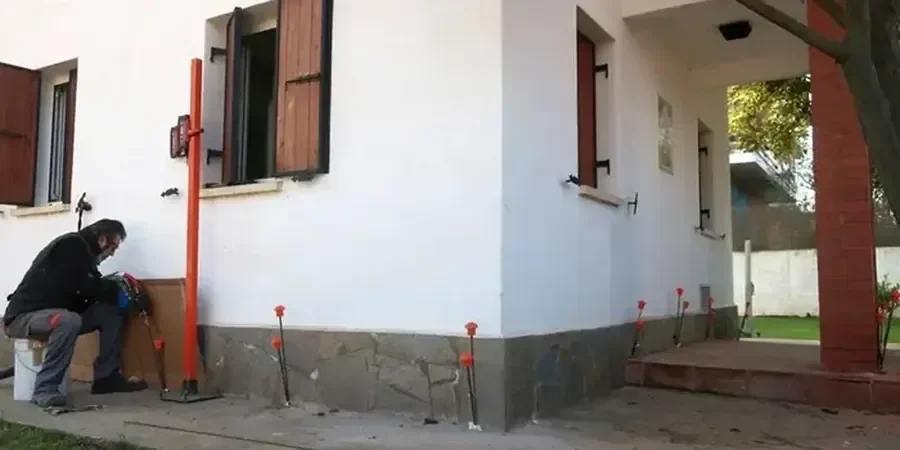
A 15 mm differential across a 6 m bay can crack a masonry wall. We quantify that risk before the first pour.
Scope of work
Area-specific notes
London's urban fabric grew over centuries of infilled docks, buried waterways and rubble from the Great Fire and the Blitz. Those historical fills are notoriously heterogeneous. A building on the Strand may straddle old river channels with alluvium up to 8 m thick, while the neighbouring plot sits on intact clay. Differential settlement analysis in London is not just about soil mechanics — it's about reading the city's buried history. We map old stream courses using archival Ordnance Survey sheets and correlate them with borehole records from the British Geological Survey. That context, combined with modern numerical modelling, prevents costly post-construction repairs.
Standards used
BS 5930:2015 (Code of practice for ground investigations), BS EN 1997-1:2004 (Eurocode 7 – Geotechnical design), CIRIA C760 (Guidance on embedded retaining walls, settlement section)
Linked services
Phase 1 – Desk Study & Ground Model
Review of BGS borehole logs, historical maps and previous site investigations to build an initial 3D ground model. Identifies zones of made ground, buried channels and variable clay depth.
Phase 2 – In-Situ & Laboratory Testing
Targeted boreholes with SPT, undisturbed sampling, oedometer and triaxial tests. We measure stiffness, compressibility and lateral variability to populate settlement parameters.
Phase 3 – Numerical Settlement Analysis
Finite element or analytical modelling (elastic, consolidation, creep) to predict differential movement under service loads. We produce settlement contours, tilt estimates and foundation recommendations.
Typical parameters
Q&A
What causes differential settlement in London Clay?
London Clay is stiff but not uniform. Sand partings, silt laminations and desiccation cracks create localised stiffness changes. Adjacent footings can background different compression. Nearby excavations, tree roots and seasonal moisture changes also drive differential movement.
How much does a differential settlement analysis cost in London?
For a typical residential extension or small commercial building, expect between £600 and £1,700 depending on borehole depth, number of samples and modelling complexity. Larger developments with multiple boreholes and 3D FEM analysis are quoted separately.
What settlement limit does Eurocode 7 recommend for shallow foundations?
Eurocode 7 (BS EN 1997-1) suggests an allowable differential settlement of 15-25 mm for most framed structures, and 10-15 mm for loadbearing masonry. These limits are based on serviceability criteria, not ultimate failure.
Can differential settlement be fixed after construction?
Sometimes, but it is expensive. Options include underpinning with micro-piles, jacking and grouting, or installing compensation grouting. Prevention through a solid differential settlement analysis before pouring foundations is far more cost-effective.