London's urban expansion over the last century has seen the city grow over a complex sequence of River Terrace Gravels, London Clay and deeper Thanet Sand Beds. This post-glacial layering creates significant variations in ground stiffness and natural period, which directly influence how seismic waves propagate through the subsurface. For any project exceeding two storeys on soft alluvium or infilled ground, a tailored seismic microzonation study is essential to classify the site according to Eurocode 8 or NEHRP criteria. We correlate shear-wave velocity profiles from MASW surveys with borehole stratigraphy to map Vs30 contours across the borough, ensuring the design spectrum matches the actual ground conditions rather than relying on generic regional maps.
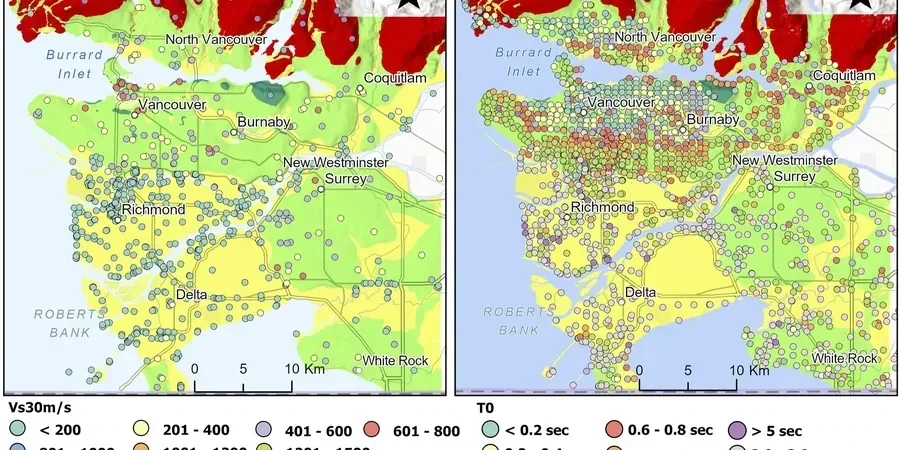
A Vs30 difference of just 80 m/s can shift a site from Ground Type B to C under Eurocode 8, altering the elastic response spectrum by up to 25%.
Scope of work
Area-specific notes
A nine-storey residential block on the South Bank near Lambeth recently showed how ignoring local microzonation can backfire. The design originally assumed Ground Type B based on a single borehole in Terrace Gravel, but our HVSR survey revealed a strong resonance peak at 1.2 Hz, indicating a much thicker soft layer than expected. That mismatch would have led to a 30% under-estimation of spectral acceleration at the building's natural period. We recommended a site-specific response spectrum analysis, and the foundation design was revised to include deeper piles and a flexible ground-floor structure to decouple the building from the amplified motion.
Standards used
Eurocode 8 (BS EN 1998-1:2004) – seismic design, NEHRP Recommended Provisions (FEMA P-1050), ASCE/SEI 7-16 – Minimum Design Loads for Buildings, BS 5930:2015 – Code of practice for site investigations, BS 1377/D4428M-14 – MASW testing standard
Linked services
Ambient Vibration Array (HVSR + MASW)
Non-invasive survey using 24-channel seismograph and 4.5 Hz geophones. Suitable for built-up areas where drilling is restricted. Output includes Vs30, site class, predominant period and amplification factors per Eurocode 8.
Downhole Seismic Profiling
Borehole-based measurement of P- and S-wave velocities using a three-component geophone locked at 1-metre intervals. Provides direct Vs profile to 50 m depth. Required for high-rise projects on deep alluvium or infilled ground.
Typical parameters
Q&A
What is the difference between seismic microzonation and a standard site response study?
Seismic microzonation maps the spatial variation of ground response across a district or borough, combining Vs30 contours, resonance frequencies and amplification factors. A standard site response study typically evaluates a single parcel. For London boroughs with variable drift thickness — such as Tower Hamlets or Lambeth — microzonation is more efficient for masterplan developments.
How much does a seismic microzonation study for a London site cost?
For a typical 2-hectare site with 6 to 10 HVSR stations and two MASW lines, the study ranges between £3.210 and £11.910 depending on access constraints, data density and the need for downhole calibration. Costs increase if borehole logging or laboratory dynamic testing is required.
Which London boroughs have the highest seismic amplification risk?
Boroughs underlain by thick alluvium or peat — such as parts of Newham, Barking and Dagenham, and the Lea Valley corridor — show amplification factors up to 1.7 for short-period structures. Central London on stiff London Clay typically amplifies less, but infilled dockside areas (e.g. Isle of Dogs) can exhibit unexpected resonance.
Do I need seismic microzonation for a low-rise residential project in London?
For a two-storey house on competent Terrace Gravel, microzonation is rarely required. However, if the site is on made ground, soft alluvium or adjacent to a watercourse, a targeted HVSR survey costs little and can prevent costly retrofits later. We recommend it for any building with a natural period below 0.5 s on soft soil.