Ground investigation in London is a fundamental step in any construction or civil engineering project, designed to characterise the subsurface conditions of a site. This category encompasses a suite of in-situ and laboratory techniques aimed at determining soil and rock properties, groundwater levels, and potential geotechnical hazards. In a densely built urban environment like London, where historical development, buried infrastructure, and complex ground conditions converge, a robust investigation is not merely a precaution but a necessity. It provides the essential data required for safe and economical foundation design, retaining wall construction, and excavation planning, directly mitigating risks such as differential settlement, slope instability, or unexpected ground obstructions.
The geology of London is dominated by the London Basin, a synclinal structure filled with sedimentary deposits. The most significant unit for engineering is the London Clay Formation, a stiff, overconsolidated clay known for its high shrink-swell potential and influence on deep foundations. Overlying the London Clay are Quaternary deposits including layers of River Terrace Gravels, which are often water-bearing, and alluvium along the Thames floodplain. In some areas, the crucial Lambeth Group sands and clays, which can contain pressurised groundwater, underlie the London Clay. This varied stratigraphy means ground conditions can change dramatically across a single postcode, from the gravel-capped hills of Islington to the deep alluvial deposits in the Docklands. A thorough investigation must identify the depth and thickness of these layers, as the presence of water-bearing gravels over clay can dictate the method of basement construction and temporary works.
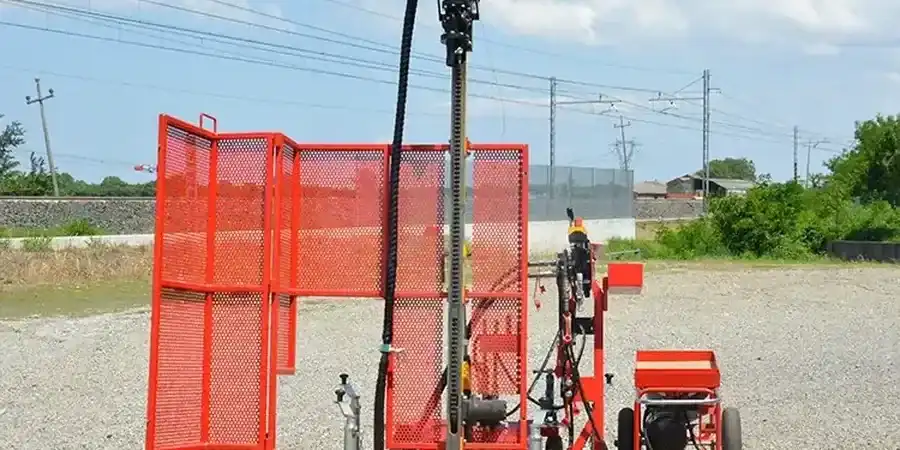
All ground investigation work in the UK must comply with the rigorous standards set out in Eurocode 7 (BS EN 1997), specifically Parts 1 and 2, which supply a framework for geotechnical design. The execution of field tests is governed by a series of British Standards, such as CPT (Cone Penetration Test) which follows BS EN ISO 22476-1, and SPT (Standard Penetration Test) performed in accordance with BS EN ISO 22476-3. The selection of an appropriately qualified contractor and the supervision of works by a geotechnical engineer are critical to ensure compliance with these standards. Furthermore, the investigation must address potential contamination, aligning with the Environment Agency's Land Contamination Risk Management framework, and consider the impact on buried utilities, requiring diligent use of permit-to-dig systems and careful execution of techniques like the exploratory test pit for service clearance.
The requirement for a comprehensive ground investigation spans a vast array of projects. It is indispensable for high-rise residential towers in zones like Nine Elms, where deep piled foundations must bypass weak alluvium to bear into the London Clay. Infrastructure projects, such as Crossrail 2 or Thames Tideway, rely on continuous investigation to map geological faults and groundwater regimes. Even smaller-scale developments, like a rear extension in a Victorian terrace, require a basic understanding of foundation depths and tree-related clay shrinkage. Basement excavations, a common feature in London's prime residential areas, demand detailed parameters for the design of propped or anchored retaining walls, making in-situ tests like the CPT and SPT, combined with laboratory strength testing, the cornerstone of a safe and buildable design.
Quick answers
What is the primary purpose of a ground investigation in London?
The primary purpose is to create an accurate ground model that defines soil and rock strata, groundwater conditions, and potential contamination. This model is essential for designing safe, cost-effective foundations and earthworks, and for managing risks associated with London's complex geology, such as shrinkable clays, water-bearing gravels, and man-made obstructions.
How does London's geology specifically influence the scope of a ground investigation?
London's geology, particularly the shrink-swell behaviour of London Clay and the presence of water-bearing River Terrace Gravels, dictates the need for depth-specific testing. Investigations must often extend deep enough to assess the Lambeth Group sands for pressurised water, and the cyclical nature of the clay requires careful laboratory testing to predict long-term volume changes affecting shallow foundations.
Which British Standards are most relevant to a ground investigation?
The overarching framework is Eurocode 7 (BS EN 1997-1 and 2). Execution standards include BS EN ISO 22475-1 for drilling and sampling, BS EN ISO 22476-1 for Cone Penetration Tests, and BS EN ISO 22476-3 for Standard Penetration Tests. The investigation must also consider the Association of Geotechnical and Geoenvironmental Specialists (AGS) data format for reporting.
At what stage of a project should a ground investigation be commissioned?
A ground investigation should be commissioned as early as possible, typically after an initial desk study but before detailed design begins. For many London projects, a phased approach is best, starting with a preliminary investigation to inform planning, followed by a detailed investigation to supply design parameters, ensuring no surprises later during construction.