London's varied geology, from the stiff London Clay beneath the central basin to the alluvial gravels of the Thames floodplain and the sandy terraces of the suburbs, imposes contrasting demands on pavement design. The long, damp winters and occasional summer downpours can saturate subgrades rapidly, making the soaked Laboratory CBR test a critical indicator of bearing capacity under worst‑case moisture conditions. This controlled test, performed on remoulded or undisturbed specimens, delivers the CBR value that directly informs flexible pavement thickness and unbound layer specifications for roads, cycleways and hardstanding areas across Greater London.
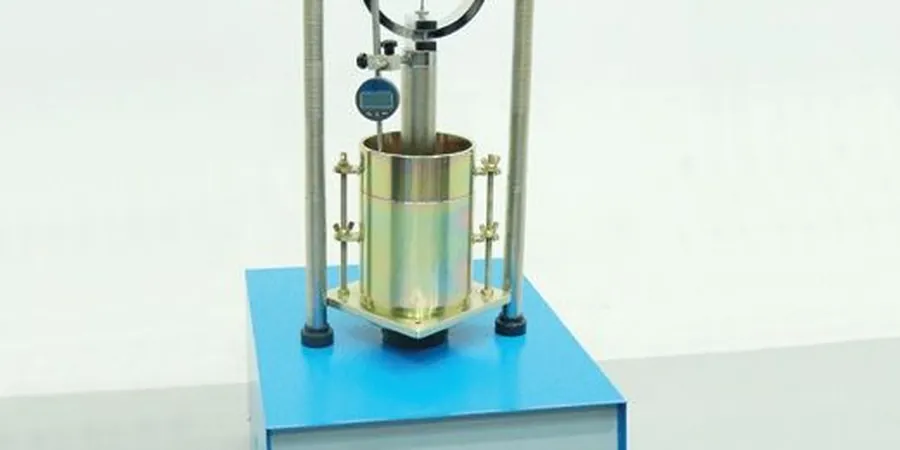
For London's clay subgrades, soaked CBR values typically range from 2 to 5%, directly controlling pavement thickness design under DMRB standards.
Scope of work
Area-specific notes
A common oversight on London sites is testing only at natural moisture content, ignoring the four‑day soak. This can overestimate CBR by a factor of two or more on clay subgrades, leading to under‑designed pavements that rut or crack within the first winter. Another pitfall is using remoulded specimens that do not represent the in‑situ density or structure of stiff London Clay. For critical layers, combining the CBR with a placa-de-carga field test provides a direct stiffness check that validates the laboratory prediction.
Standards used
BS 1377‑4:1990 (Soaked CBR test), BS EN 13286‑47:2004, DMRB CD 225 (Design for new pavement foundations)
Linked services
Standard Soaked CBR (BS 1377‑4)
Full four‑day soak followed by penetration test at 1.0 mm/min. Reported at 2.5 mm and 5.0 mm penetration. Suitable for cohesive and granular subgrades. Includes compaction at 2.5 kg or 4.5 kg rammer energy as per project specification.
CBR on Undisturbed Samples
Test performed on undisturbed block or tube samples recovered from the subgrade. Preserves natural moisture and density. Ideal for stiff London Clay where remoulded values would be unrepresentative. Includes density and moisture content determination.
Typical parameters
Q&A
What is the difference between soaked and unsoaked CBR, and which one is used in London?
The soaked CBR simulates worst‑case field moisture after prolonged rainfall or rising groundwater, while the unsoaked test reflects as‑compacted conditions. For London's clay subgrades, soaked CBR is almost always specified because seasonal wetting can reduce strength significantly. The design standard DMRB CD 225 requires soaked CBR values for pavement foundation design.
How much does a Laboratory CBR test cost in London?
A standard soaked CBR test including compaction typically ranges between £100 and £160 per specimen, depending on the compaction energy required and whether the material needs prior classification. Undisturbed sample testing may be at the upper end of that range. Volume discounts apply for multiple specimens from the same project.
Can Laboratory CBR replace a field plate load test for pavement design?
No, they serve different purposes. The CBR is a penetration index used for empirical pavement thickness design (e.g., DMRB or AASHTO methods), while the plate load test measures the actual modulus of subgrade reaction (k‑value) under static load. For high‑spec pavements, both tests are often run: CBR for thickness design and plate load for stiffness verification at formation level.