The difference between building on the dense Terrace Gravels beneath Mayfair and the loose hydraulic fill of the former Royal Docks is dramatic. Soils in the Thames floodplain often sit at relative densities below 40 percent, while the gravels of Hampstead can exceed 80 percent. A vibrocompaction design for London must account for that spatial variability. We calibrate probe spacing and vibration energy using site-specific grain size curves and CPT profiles. The goal is a uniform, high-density mass that eliminates differential settlement risk. Before finalising the treatment grid, we run a CPT sounding to confirm the pre-treatment stratification.
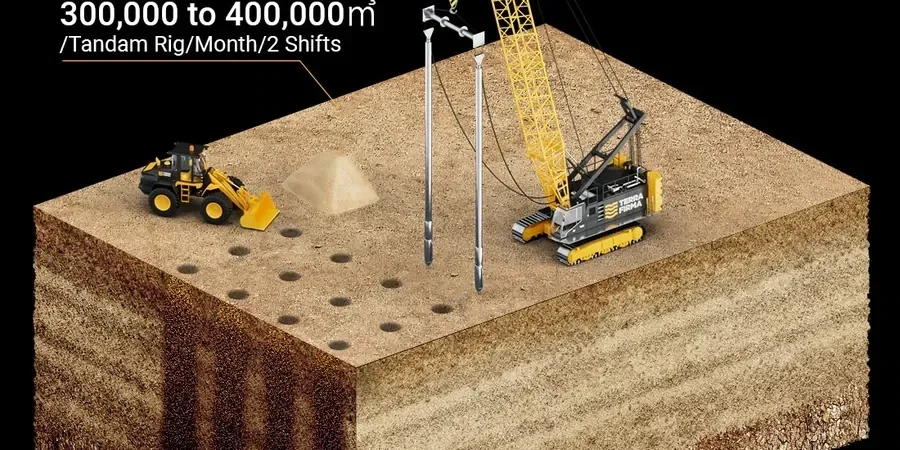
A 15 percent fines content shifts the required compaction grid from 2.5 m to 1.8 m — a detail that saves costly re-treatment.
Scope of work
Area-specific notes
London's urban growth has pushed construction onto reclaimed docklands and former landfill sites along the Thames Gateway. These man-made grounds often contain building rubble, timber piles, and variable fills. If a vibrocompaction design ignores the buried obstructions, probes can deviate or break. Worse, untreated soft pockets can lead to serviceability failures under working loads. We always review historical borehole records from the British Geological Survey and cross-check with a pre-treatment geophysical survey. Without that step, the risk of a post-compaction gap is real.
Standards used
BS EN 1997-2:2007 (Eurocode 7 – Ground investigation and testing), BS 5930:2015 (Code of practice for ground investigations), CIRIA C579 (Vibro techniques in the UK)
Linked services
Feasibility study and site screening
Review of existing boreholes, BGS records, and grain size distribution to confirm vibrocompaction is technically viable for the specific London formation.
Detailed compaction design
Calculation of probe spacing, energy per metre, and backfill volume tailored to the target relative density and soil layering.
Post-treatment QA/QC programme
Field verification using CPT and SPT at a density of one test per 500 m², plus settlement monitoring plates during proof loading.
Typical parameters
Q&A
What is the difference between vibrocompaction and stone columns?
Vibrocompaction densifies the native soil using a vibrating probe without adding granular material, while stone columns replace or displace soil with crushed stone. Vibrocompaction works best in clean sands and gravels; stone columns are used when fines exceed 15 percent or when drainage improvement is the primary goal.
Can vibrocompaction be applied to London Clay?
No. London Clay has a plasticity index above 40 percent and a fines content close to 100 percent. Vibrocompaction requires free-draining granular soils. For cohesive clays, alternatives such as deep soil mixing or jet grouting are more appropriate.
How much does vibrocompaction design cost in London?
A detailed design package covering feasibility, compaction grid, and QA/QC specification typically ranges between £1,240 and £4,480 depending on site area and complexity. This excludes field verification tests, which are billed separately.
What verification tests are required after compaction?
The standard protocol includes CPT soundings at a density of one per 500 m² and SPT borings at one per 1,000 m². We also recommend plate load tests on at least two trial areas to confirm the modulus of subgrade reaction and settlement under working loads.