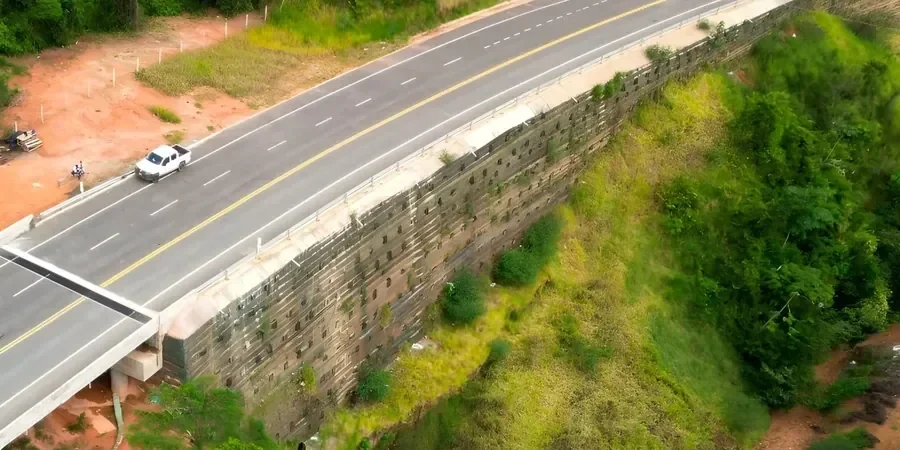
We recently supervised an MSE wall for a 35-metre retaining structure along a new road embankment near the M25 junction in west London. The client needed a solution that could handle the soft alluvial clays of the Thames floodplain while keeping construction time tight. In our background, mechanically stabilized earth walls offer the best balance of flexibility and load capacity for these conditions. Before finalizing the reinforcement layout, we always run a plate load test on the foundation soil to verify bearing stiffness and limit differential movement. The data from that test directly informs the design parameters for the geogrid layers.
In London Clay, the long-term creep behaviour of the foundation governs the allowable reinforcement strain — not the short-term peak strength.
Scope of work
Area-specific notes
Eurocode 7 (EN 1997-1:2004) classifies MSE walls under Design Approach 1, which requires checking both material and geotechnical partial factors. In London, the main risk comes from the combination of high groundwater in the terrace gravels and the low drained strength of the underlying clay. If the wall is built during a wet winter, pore pressures can rise quickly and reduce the effective stress in the reinforced zone. That is why we install vibrating-wire piezometers behind every wall taller than 8 metres and monitor readings weekly during the first rainy season. Ignoring that monitoring step has led to at least two notable failures in the Greater London area over the past decade.
Standards used
BS 8006-1:2010 — Code of practice for strengthened/reinforced soils, Eurocode 7 (EN 1997-1:2004) — Geotechnical design, BS 5930:2015 — Code of practice for ground investigations, BS 1377 — Standard test method for geogrid tensile properties
Linked services
Full MSE wall design and verification
We prepare reinforcement layouts, stability calculations, and construction drawings using limit-equilibrium software (SLOPE/W and ReSSa). The deliverable includes a geotechnical design report signed by a chartered engineer, covering both ultimate and serviceability limit states under Eurocode 7.
Site investigation for MSE walls
We coordinate boreholes, CPT soundings, and laboratory triaxial tests to obtain the design parameters for the foundation and backfill. The investigation follows BS 5930 and includes a detailed groundwater monitoring plan to address the specific risks of the Thames basin geology.
Typical parameters
Q&A
What is the typical cost range for an MSE wall design in London?
For a standard project (wall height 6–12 m, length 50–100 m), the design and site investigation package typically falls between £1.060 and £4.140, depending on the number of reinforcement layers and the complexity of the foundation conditions. A detailed quote is provided after the initial site walkover.
How long does an MSE wall design take from start to finish?
A complete design cycle — including site investigation, laboratory testing, stability analysis, and drawing production — usually takes 4 to 6 weeks for a typical urban project in London. If the wall is located near existing infrastructure (e.g., a railway cutting or a deep basement), the timeline may extend to 8 weeks to allow for additional monitoring and sensitivity checks.
Which geogrid type do you recommend for London Clay conditions?
We recommend high-tenacity polyester (PET) geogrids with a minimum long-term design strength of 60 kN/m and a creep-limited strain below 2% at 120 years. Polypropylene grids are not suitable for permanent walls in London Clay because their creep behaviour is too sensitive to the sustained loads typical in this geology.
Can an MSE wall be built on a site with high groundwater?
Yes, but the design must include a drainage blanket behind the wall face and a toe drain to control pore pressures. In London’s terrace gravels, we typically specify a 300 mm granular drainage layer wrapped in a nonwoven geotextile. We also check the internal stability using submerged unit weights and apply a reduction factor of 1.2 to the geogrid pullout resistance when the water table is within 2 m of the base.