London sits on a varied sequence of Thames gravel, London Clay, and alluvial deposits that shift dramatically within a few hundred meters. The River Thames floodplain, combined with historical land use from Roman settlements to Victorian railways, creates a subsurface that demands careful road geotechnics before any pavement design begins. In our background, relying on published geological maps alone can lead to surprises when the CBR drops below 2% in unexpected pockets of soft ground. That is why we always start with a targeted site investigation, pairing calicatas exploratorias for visual logging with ensayo SPT to correlate blow counts with subgrade stiffness. The underlying principle is simple: the strength of the formation dictates the pavement thickness, and London clay can vary from firm to very stiff depending on its depth and weathering.
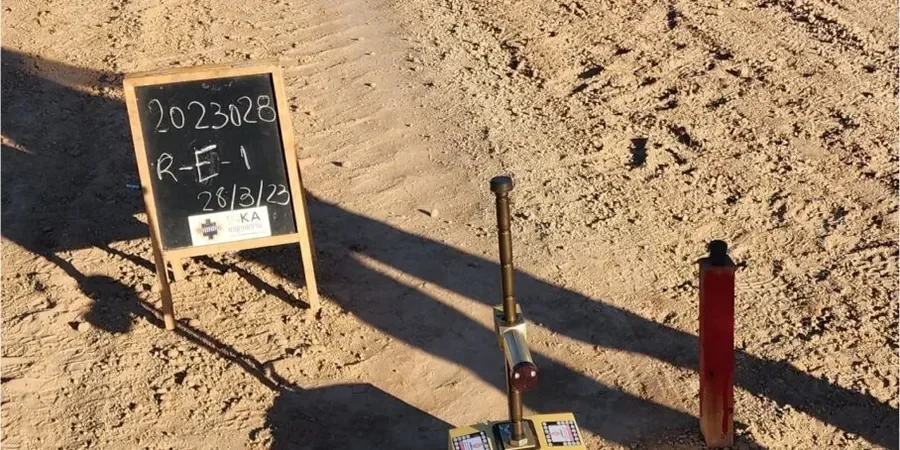
A subgrade compacted 2% dry of optimum can lose half its stiffness, making CBR validation non-negotiable before pavement design.
Scope of work
Area-specific notes
What we see most often in London is a mismatch between the design CBR assumed by the pavement engineer and the actual value measured after stripping topsoil. The made ground across the city includes everything from Victorian ash to demolition rubble, and its CBR can be as low as 1% when wet. Another recurring issue is the presence of high-plasticity clay beneath the proposed pavement, which swells when unloaded and then shrinks under traffic, leading to longitudinal cracking. Our practice is to install instrumentación geotécnica like settlement plates and moisture probes on sensitive sections to monitor post-construction behavior. We also flag areas where the water table sits within 0.5 m of the formation level, because that alone can reduce the effective CBR by half and accelerate fatigue cracking in the asphalt layer.
Standards used
BS 5930:2015 – Code of practice for ground investigations, BS 1377-9:1990 – Methods for in-situ CBR testing, SHW Series 600 – Specification for Highway Works in the UK, Eurocode 7 (EN 1997-2:2007) – Geotechnical design
Linked services
Subgrade Investigation & CBR Testing
In-situ and laboratory CBR tests following BS 1377-9, combined with dynamic cone penetrometer profiles to map subgrade strength variability across the site.
Compaction Control & Proctor Testing
Standard and modified Proctor tests per BS 1377-4 to establish compaction curves, plus field density checks using the sand replacement method or nuclear gauge.
Pavement Layer Design Support
Data interpretation for flexible and rigid pavement design, including resilient modulus estimation from CBR and correlation with traffic class per UK DMRB standards.
Groundwater & Drainage Assessment
Permeability testing in standpipes and observation wells to evaluate drainage requirements, particularly in low-lying areas near the Thames or along the Lea Valley.
Typical parameters
Q&A
What is the typical CBR value for London Clay as a subgrade?
For firm to stiff London Clay, soaked CBR values range between 2% and 5%. Weathered clay near the surface can drop to 1.5%, while deeper unweathered clay may reach 8%. We always recommend site-specific testing because the CBR can vary laterally within the same formation.
How much does a road geotechnics study for pavement design cost in London?
A typical investigation for a small residential access road starts around £670, while a full study for a major highway with multiple trial pits and laboratory testing can go up to £3,470. The final price depends on the number of test locations, the depth of investigation, and whether soakaway or drainage testing is required.
Do I need a CBR test if the subgrade looks uniform?
Yes, because visual appearance is not a reliable indicator of strength. We have seen apparently identical clay layers produce soaked CBR values of 2.5% and 6.5% just 20 meters apart. Without testing, you risk under-designing the pavement thickness, which leads to early failure, or over-designing, which wastes material.
What makes London subgrades different from other UK cities?
The presence of deep made ground from centuries of urban development, combined with high-plasticity London Clay and a fluctuating water table influenced by the Thames, creates a more variable and often weaker subgrade than in cities built on uniform glacial till or chalk. We also encounter old basements, tunnels, and foundations that affect compaction and drainage.