London's rapid expansion since the Victorian era has pushed construction into increasingly challenging ground. The city sits on a sequence of River Terrace Gravels, London Clay, and the deeper Lambeth Group. These layers vary drastically over short distances. A thorough soil mechanics study in London is the only way to map those variations before you break ground. We combine historical borehole records with new drilling to build a reliable ground model. This phase is critical for selecting foundation type and depth. Without it, you risk differential settlement or underpinning costs later. We also integrate MASW-Vs30 surveys where seismic site classification is required for tall structures or basement excavations.
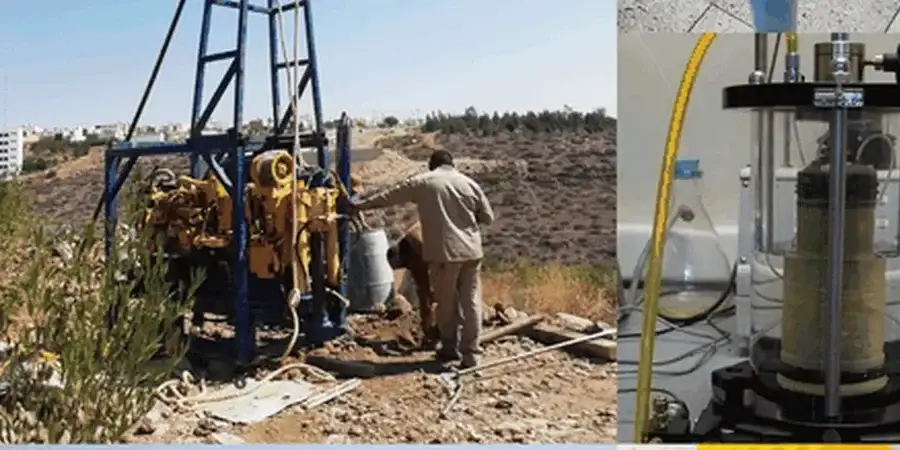
A single borehole in London Clay can show strength variation of 150% within 10 metres. That is why we never rely on one log alone.
Scope of work
- Rotary core drilling with triple-tube barrels for undisturbed sampling
- SPT energy measurements calibrated to BS EN ISO 22476-3
- In-situ permeability tests using rising/falling head methods
- Installation of standpipe piezometers for long-term monitoring
Area-specific notes
We see contractors skip the soil mechanics study because the site is 'just clay'. That is a costly mistake. London Clay is not uniform. Glacial erosion channels, buried river channels and solution features in the Chalk create sudden weak zones. A building designed for 200 kPa bearing capacity can hit a soft spot with only 80 kPa. The result is differential settlement, cracked finishes and expensive grouting repairs. A proper study with multiple boreholes spaced per BS 5930 catches these anomalies. It costs a fraction of the remedial work.
Watch how it works
Standards used
BS 5930:2015 (Code of practice for ground investigations), Eurocode 7 (EN 1997-1:2004) – Geotechnical design, BS EN ISO 22476-3 (SPT standard), NHBC Standards Chapter 4.2 (residential ground investigation)
Linked services
Desk Study & Walkover Survey
Review of historical maps, BGS records and previous borehole logs. We identify constraints before mobilising any rig.
Rotary Core Drilling & Sampling
Triple-tube coring to 50 m depth in London Clay. Undisturbed samples for triaxial and oedometer testing.
Geotechnical Laboratory Testing
UKAS-accredited suite including Atterberg limits, particle size distribution, Proctor compaction and shear strength.
Interpretative Geotechnical Report
Factual logs, laboratory results and design parameters. We include foundation recommendations and slope stability analysis if required.
Typical parameters
Q&A
How many boreholes are needed for a soil mechanics study in London?
For a typical residential plot (up to 0.1 ha), we recommend 2 to 3 boreholes to 10–15 m depth. Larger developments require a grid pattern per BS 5930. The spacing depends on the geology variability and building load.
What is the difference between a soil mechanics study and a site investigation?
A site investigation is the broader process of drilling, sampling and testing. A soil mechanics study is the analytical phase that interprets those results into design parameters — bearing capacity, settlement, shear strength and groundwater conditions. Both are part of the same workflow.
Does London Clay always require piled foundations?
No. For low-rise structures on stiff London Clay, shallow strip footings can work if the soil mechanics study confirms adequate strength and low shrink-swell potential. Piles become necessary for heavy loads, deep basements or where the clay is soft near surface.
How long does a soil mechanics study in London take?
A standard study including drilling, lab testing and reporting takes 4 to 6 weeks. Fast-track projects with reduced testing or existing borehole data can be completed in 2 to 3 weeks. We always coordinate with the project programme.
What is the typical cost of a soil mechanics study in London?
The cost ranges from £2,560 to £4,530 depending on the number of boreholes, depth, and laboratory testing scope. Complex sites with multiple strata or deep groundwater monitoring may exceed this range. We supply a fixed price after reviewing the site constraints.