London sits on a thick sequence of London Clay, chalk, and river terrace gravels, with negligible historical seismicity. Yet seismic foundation design remains critical for critical infrastructure and tall buildings. The UK National Annex to Eurocode 8 (BS EN 1998-1:2004) classifies most of the city as low seismicity, but local soil amplification can still occur. For projects near the Thames or on reclaimed land, we combine borehole data with MASW-Vs30 surveys to define shear-wave velocity profiles and site class correctly. This ensures the foundation system matches the actual ground response.
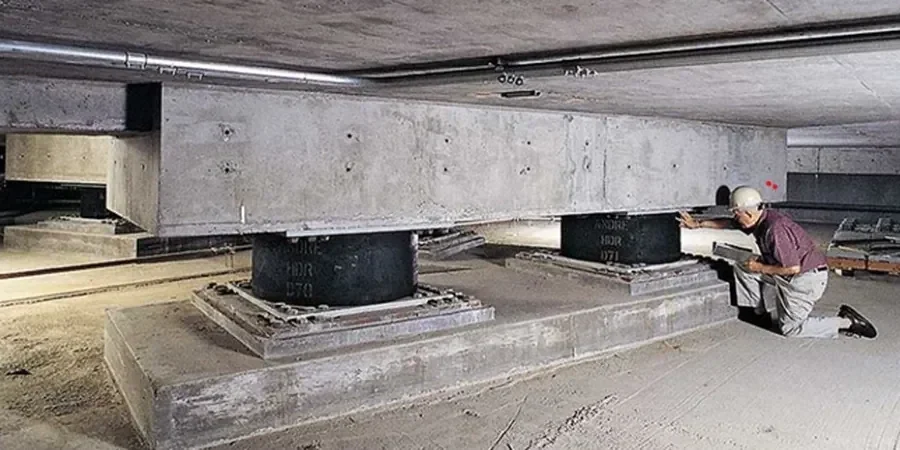
London Clay can amplify low-frequency seismic waves by up to 30% in tall buildings, making site-specific ground response analysis essential for safe seismic foundation design.
Scope of work
- Boreholes to 30 m depth with SPT and CPT soundings
- Laboratory resonant column tests on undisturbed London Clay samples
- Site classification per BS EN 1998-1 (ground type C for the alluvium)
Area-specific notes
The main seismic risk in London is not ground shaking intensity — it is soil-structure interaction and liquefaction of loose sands in the Thames floodplain. Areas like Westminster and Southwark have dense gravels with low amplification, but sites in Greenwich or the Isle of Dogs may background moderate amplification. For a hospital project in Southwark, we modelled a 5‑storey shear wall building on a raft foundation. The analysis showed a 20% increase in base shear due to soil compliance. We mitigated it with a stiffened raft and reinforced ground beams, following a detailed liquefaction assessment.
Standards used
BS EN 1998-1:2004 (Eurocode 8 – Seismic Design of Structures), BS EN 1997-1:2004 (Eurocode 7 – Geotechnical Design), BRE Digest 412 – Seismic Design of Buildings in the UK, NCEER/NSF – Youd & Idriss (2001) Liquefaction Triggers
Linked services
Ground Response Analysis & Site Classification
One-dimensional equivalent-linear and nonlinear ground response analysis using DEEPSOIL. We determine site class per Eurocode 8 and compute acceleration response spectra for the design base shear. Includes Vs30 profiling via MASW or downhole seismic testing.
Structural-Foundation Seismic Design
Integrated structural and geotechnical design of shallow and deep foundations under seismic loads. We check overturning, sliding, bearing capacity under cyclic loading, and ductility detailing per BS EN 1998-1. Deliverables include design reports, reinforcement schedules, and construction drawings.
Typical parameters
Q&A
Is seismic foundation design really necessary in London?
Yes – even low seismicity regions require it for tall buildings, hospitals, and critical infrastructure. London Clay can amplify low-frequency waves, and soil-structure interaction can increase base shear by 20% or more.
How do you determine the site class for a project in London?
We use a combination of borehole logs, SPT N-values, and shear-wave velocity profiling (MASW or downhole). The results are classified per BS EN 1998-1 Table 3.1 – typical London Clay falls into ground types B or C.
What is the typical cost range for a seismic foundation design study in London?
For a standard residential or commercial project, the study including ground response analysis and foundation design typically ranges between £1,140 and £3,500. Larger or more complex projects (hospitals, tall towers) may exceed this.
Can you use the same foundation design for a building on clay and on gravel?
No – the design must reflect the site-specific soil profile. Stiff clay may require a raft or piled raft for seismic loads, while dense gravels can often support shallow footings. We always perform a site-specific ground response analysis.
Do you provide construction supervision for seismic foundations?
Yes – we offer site inspection during piling or raft construction, check reinforcement detailing for ductility, and verify that the foundation meets the seismic design assumptions. This is part of our integrated service.