Over 9 million people live in London, and the city sits on a varied geology of London Clay, River Terrace Deposits, and Chalk. Each soil type demands precise classification before any structural load is applied. Grain size analysis (sieve + hydrometer) is the first step to understanding how a soil will behave under stress. We separate particles from gravel down to clay fractions. This data feeds directly into bearing capacity calculations and settlement predictions. Without it, you are guessing. For shallow foundations on clay, we often combine this test with a placa de carga to verify modulus values on site. The result is a clear soil classification and a reliable design parameter.
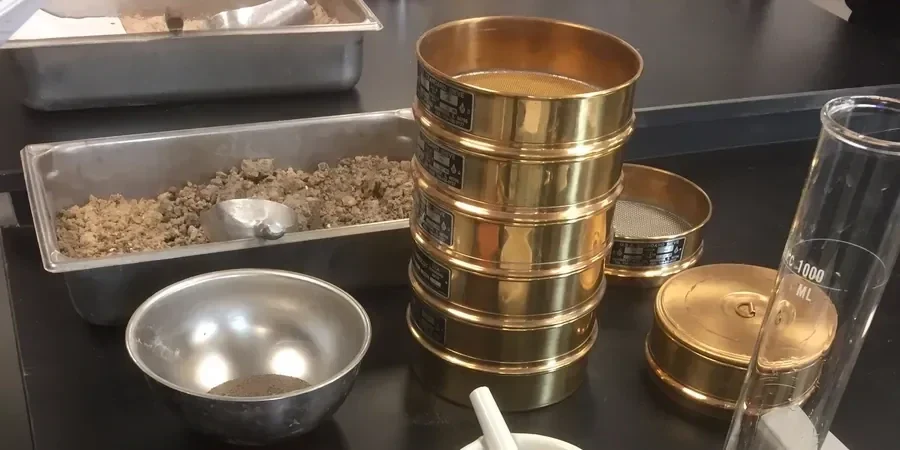
A single grain size curve can save weeks of rework. It tells you if your soil will drain, settle, or liquefy before you pour a single cubic meter.
Scope of work
Area-specific notes
London's urban development has been layered over centuries. Old foundations, made ground, and buried river channels are common across the city. A grain size analysis alone cannot detect these, but it will tell you if the fill material is uniformly graded and prone to collapse. In areas like the Lea Valley, alluvial deposits with high silt content are common. These soils can change from firm to soft within meters. If the grain size curve shows a high percentage of fines, we flag it immediately. The risk is differential settlement. A building that looks stable on one side can crack on the other if the soil varies. We use the hydrometer data to estimate the clay fraction and link it to plasticity.
Standards used
BS 1377-2:1990 (Methods of test for soils — Classification tests), BS 5930:2015 (Code of practice for ground investigations), BS 1377-2 (Standard test methods for particle-size distribution), BS 1377 (Standard test method for particle-size distribution — hydrometer)
Linked services
Dry Sieve Analysis (Coarse Soils)
For sands and gravels. We use a stack of sieves from 75 mm down to 63 µm. The sample is dried and shaken mechanically for 10 minutes. We report the full gradation curve and the D10, D30, D60 values. Ideal for assessing filter materials and drainage layers.
Wash Sieve + Hydrometer (Fine Soils)
For clays and silts. The sample is washed through a 63 µm sieve. The retained coarse fraction is dry-sieved. The fines are suspended in water with a dispersant. We take hydrometer readings over 24 hours to track the settling rate. This gives us the full distribution down to clay size.
Combined Grading Report
A single report that merges dry sieve and hydrometer data into one continuous curve. We calculate the coefficient of uniformity and curvature. The result is a USCS or AASHTO soil classification. This is the standard deliverable for foundation design in London.
Typical parameters
Q&A
What is the difference between sieve and hydrometer analysis?
Sieve analysis separates particles larger than 63 µm using a stack of sieves. The hydrometer method measures particles smaller than 63 µm by tracking how fast they settle in water. Sieve gives you the gravel and sand fractions. The hydrometer gives you the silt and clay fractions. Together they produce a complete grain size curve from 75 mm down to 0.002 mm.
How much does a grain size analysis cost in London?
A standard combined sieve and hydrometer test typically ranges between £80 and £140 per sample depending on the number of hydrometer readings required. The price includes the full curve, coefficients, and a USCS classification. Volume discounts apply for projects with more than ten samples.
Why do I need a hydrometer test for London Clay?
London Clay contains a significant percentage of particles smaller than 63 µm. A dry sieve alone would classify it as 100% fines, which tells you nothing. The hydrometer breaks down that fine fraction into silt and clay percentages. This is critical because the clay fraction controls the soil's plasticity, swelling potential, and drained strength. Without it, you cannot estimate settlement accurately.